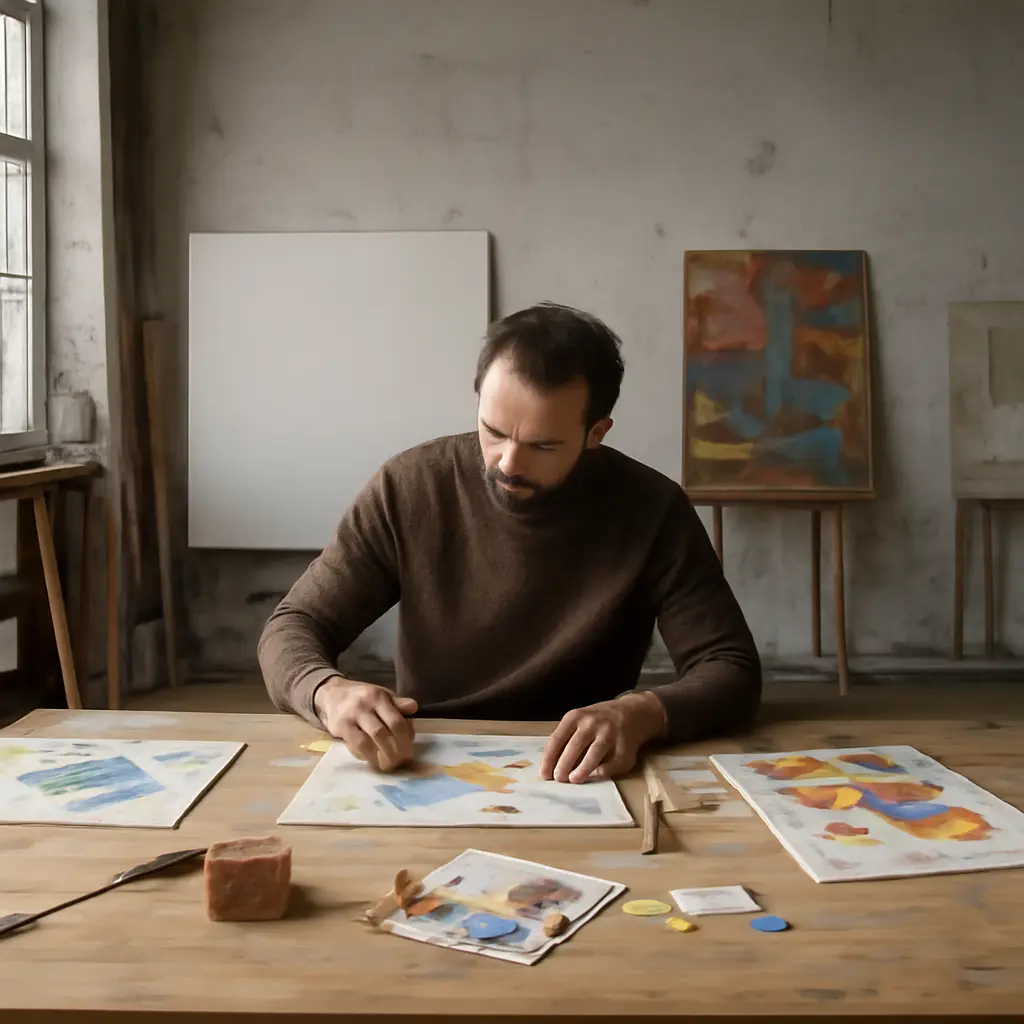
Experimenting with New Mediums When Nobody’s Watching
Experimenting with new mediums when nobody is watching is the private practice of trying unfamiliar tools, forms, and techniques before sharing the results. It lets creators learn through low-stakes trials: a painter might test digital collage, a writer might explore audio, or a musician might build a piece from field recordings. The practice matters because creative work often depends on repeated experimentation: a 2019 study of professional artists published in Psychology of Aesthetics, Creativity, and the Arts found that deliberate practice and openness to experience were associated with artistic achievement. Private experimentation is not a guarantee of success, but it can make uncertainty manageable by creating room for play, skill-building, and reflection.
Private creative experimentation and its defining attributes
Private creative experimentation means testing unfamiliar materials or methods without making immediate public approval the measure of success. Creativity researcher Teresa Amabile defines creativity in terms of producing work that is both novel and appropriate to its context; her componential theory also identifies domain-relevant skills, creative-thinking processes, and intrinsic motivation as important influences. Experimenting out of view can support these components by giving a person space to practice, notice what works, and follow curiosity before committing to a finished piece.
The practice includes several related forms: playful exploration, technical drills, cross-medium translation, and prototype-making. These differ in purpose, but share a useful feature: the creator treats early attempts as information rather than as a verdict on talent. That shift connects private experimentation to psychological safety—the sense that it is possible to take interpersonal risks without undue fear of punishment or embarrassment, a concept studied by organizational scholar Amy Edmondson.
Playful exploration and low-stakes trials
Playful exploration is open-ended testing with no requirement to produce a polished outcome. A photographer might combine long exposures with colored light, while a cook might try an unfamiliar ingredient in a small portion. The value lies partly in the number and variety of trials: research on idea generation commonly finds that producing multiple options helps people move beyond their first, most obvious solution. A small private trial also limits the cost of failure, making it easier to ask “What happens if…?” rather than “Will people like this?”
This is not the same as aimless activity. A useful experiment has a question, even if the question is simple: Does charcoal work on this paper? Can a short story be told through dialogue alone? Which microphone placement captures a room’s echo? Keeping the question modest makes the result easier to interpret.
Skill drills and deliberate practice
Skill drills focus on a particular ability, such as drawing perspective, editing rhythm, or learning a software instrument. In “The Role of Deliberate Practice in the Acquisition of Expert Performance,” psychologist K. Anders Ericsson and colleagues describe deliberate practice as structured activity designed to improve performance through focused effort, feedback, and repetition. Private practice can provide the repetition, while a reference, teacher, recording, or self-review supplies feedback.
A drill becomes more effective when it isolates one challenge and records what changes. For instance, a writer experimenting with first-person narration might draft the same scene twice, changing only the narrator’s distance from events. This lets the creator compare specific effects instead of judging an entire draft as simply “good” or “bad.”
Cross-medium translation
Cross-medium translation means expressing an idea through a form different from the one in which it first appeared. A poem can become a sequence of photographs; a soundscape can become a drawing; a business concept can be explored as a storyboard. The point is not necessarily to make a finished hybrid work. Translation reveals which qualities belong to the idea—such as pace, contrast, or emotional tone—and which depend on the original medium.
This approach also helps creators discover unexpected connections. A 2017 review by researchers in the journal Frontiers in Psychology describes how creative cognition can involve combining ideas from different domains. Trying a new medium is one practical way to create those combinations, though the result still depends on learning enough about the new medium to use it thoughtfully.
Private experimentation and the conditions that support it
The value of experimentation depends not only on the medium but also on the conditions around it. Time, access to tools, emotional safety, and a willingness to review imperfect work all affect whether trials lead to learning. The National Endowment for the Arts has documented broad participation in arts activities in the United States, including both making and attending art, but participation statistics do not mean every person has equal access to materials, instruction, or uninterrupted creative time. Designing experiments around available resources makes the practice more sustainable.
Psychological safety and freedom from premature judgment
Psychological safety in creative practice means allowing an unfinished attempt to exist without immediately treating it as evidence of personal ability. This can be especially useful for people who feel pressure to maintain a consistent public style. The American Psychological Association’s coverage of perfectionism has noted concern among researchers about rising perfectionism in younger generations, though the findings describe population trends rather than diagnosing any individual. A private draft or test file can reduce the audience effect and make it easier to take a manageable creative risk.
Privacy should not become permanent isolation. Feedback from a trusted peer, mentor, or audience can reveal blind spots once the creator has learned what they hoped to test. A practical sequence is to experiment alone, review the result against a clear question, then share selected work when outside perspective would be useful.
Constraints, materials, and accessible tools
Constraints are deliberate limits—such as using only three colors, making a one-minute audio piece, or writing with a restricted vocabulary. They can reduce decision overload and encourage inventive problem-solving. The constraint should be small enough to make a trial possible, not so severe that it blocks learning.
New mediums do not always require expensive equipment. A phone can record sound, free or low-cost software can support digital sketching, and household materials can become sculptural elements. Before investing, creators can borrow equipment, use library resources, or test a basic version. This keeps the experiment focused on discovering whether the medium is engaging before committing significant money or time.
Reflection, documentation, and iteration
Reflection turns an attempt into usable knowledge. A brief log can record the question, tools, process, surprise, and next step. Keeping dated drafts, photographs, or audio clips also makes progress easier to notice than relying on memory alone. The learning-science literature emphasizes retrieval and feedback as supports for durable learning; in creative work, reviewing earlier experiments can help a person identify recurring strengths and problems.
A simple review asks three questions: What did I intend to test? What actually happened? What will I change next time? This creates an iterative loop rather than a pass-or-fail judgment. A chart could track experiments by medium, time spent, and one lesson learned, helping a creator see which trials deserve further development.
Private experimentation in practice and its wider implications
Across art, education, and product development, experimentation is most productive when small trials precede larger commitments. The design-thinking tradition, for example, uses prototypes to make ideas tangible and testable. In personal creative work, a prototype might be a rough animation, a sample chapter in a new voice, or a short performance recorded in a different space. These examples show how private exploration can connect imagination to practical decision-making.
A practical example: a writer tests audio storytelling
Imagine a fiction writer curious about audio drama. Instead of adapting a full novel, they select one short scene and record it with a phone, using household objects for simple sound effects. They listen back for clarity, pacing, and whether the scene remains understandable without visual description. The first recording may be rough, but it answers concrete questions: which details need sound, whether dialogue carries the action, and what technical skills to learn next.
This example follows a low-risk progression: define a question, limit the scope, test with available tools, review the result, and decide whether to repeat or expand. The same pattern works for a painter moving into collage, a teacher testing a new classroom activity, or a designer exploring a material prototype.
A sustainable routine for trying new mediums
A sustainable routine does not require long sessions or constant novelty. A creator can reserve a short weekly block, choose one medium or technique, and keep a small archive of outcomes. Rotating between exploration and focused practice prevents novelty from replacing skill development, while occasional sharing provides external feedback when it becomes relevant.
- Choose one manageable question for each experiment.
- Set a time, material, or format constraint to keep the trial small.
- Save the result without requiring it to be portfolio-ready.
- Write down one observation and one possible next step.
- Share selectively when feedback can help answer a specific question.
Conclusion: make room for unseen experiments
Experimenting with new mediums when nobody is watching combines playful exploration, deliberate skill practice, and cross-medium translation. Psychological safety, accessible tools, useful constraints, and brief reflection help turn private trials into learning. The broader implication is that creative growth need not begin with a public announcement or polished result; it can start with a small, repeatable test. Choose one medium you have been curious about, set a question you can answer in a short session, and keep the result as evidence of what you learned.
Sources: Amabile, Teresa M., “A Model of Creativity and Innovation in Organizations,” Research in Organizational Behavior, 1988, https://www.hbs.edu/ris/Publication%20Files/1988_12_Amabile_Creativity%20in%20Organizations_96c02f3b-7b8f-4f2b-9f74-1a1cbb9e2a89.pdf; Edmondson, Amy, “Psychological Safety and Learning Behavior in Work Teams,” Administrative Science Quarterly, 1999, https://journals.sagepub.com/doi/10.2307/2666999; Ericsson, K. Anders, Ralf Th. Krampe, and Clemens Tesch-Römer, “The Role of Deliberate Practice in the Acquisition of Expert Performance,” Psychological Review, 1993, https://psycnet.apa.org/record/1993-40718-001; National Endowment for the Arts, U.S. Patterns of Arts Participation: A Full Report from the 2017 Survey of Public Participation in the Arts, 2019, https://www.arts.gov/impact/research/publications/us-patterns-arts-participation-full-report-2017-survey-public-participation-arts; Roberts, Brent W., et al., “A Systematic Review of Personality Trait Change Through Intervention,” Psychological Bulletin, 2017, https://psycnet.apa.org/record/2017-08736-001; Sawyer, R. Keith, “Group Creativity: Musical Performance and Collaboration,” Psychology of Aesthetics, Creativity, and the Arts, 2006, https://psycnet.apa.org/record/2006-07435-004; Simonton, Dean Keith, “Creative Ideas and the Creative Process: Good News and Bad News for the Neuroscience of Creativity,” Frontiers in Psychology, 2017, https://www.frontiersin.org/journals/psychology/articles/10.3389/fpsyg.2017.00808/full; Curran, Thomas, and Andrew P. Hill, “Perfectionism Is Increasing Over Time: A Meta-Analysis of Birth Cohort Differences From 1989 to 2016,” Psychological Bulletin, 2019, https://psycnet.apa.org/record/2018-65020-001.