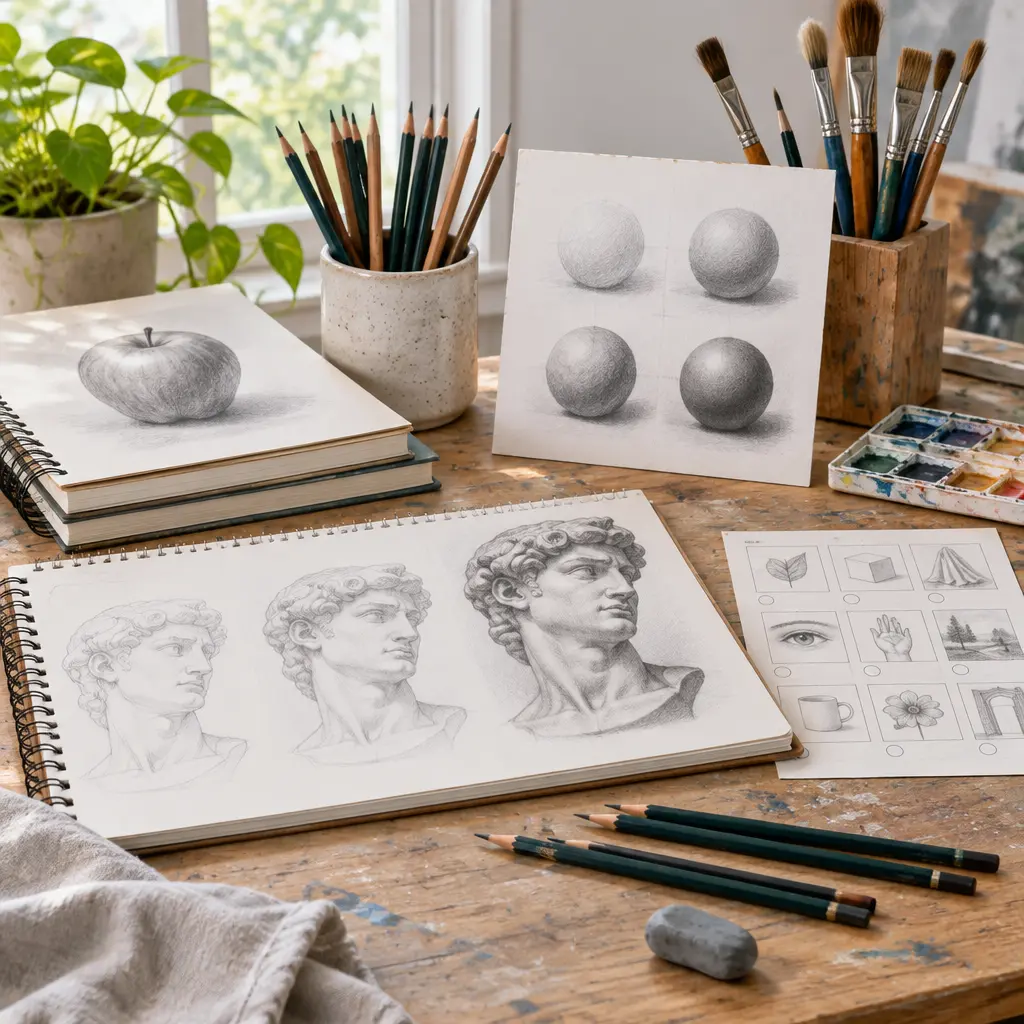
Setting Realistic Drawing Goals and Tracking Progress
Setting realistic drawing goals means choosing specific, manageable skills to practice and reviewing progress with evidence rather than relying on whether a drawing feels “good.” A useful plan balances time, difficulty, and personal interest: for example, practicing perspective for 20 minutes three times a week and comparing monthly sketches. Research on goal-setting and deliberate practice supports clear targets, focused feedback, and regular review, although drawing progress is individual and no single schedule guarantees results. The sections below explain how to set measurable goals, build sustainable practice, track improvement, and adjust a plan when life or motivation changes.
Drawing Goals Define a Practical Direction for Practice
A drawing goal is a chosen outcome or skill that gives practice direction. In its widely cited goal-setting theory, organizational psychologist Edwin A. Locke and psychologist Gary P. Latham describe goals as targets that direct attention, mobilize effort, and support persistence, particularly when they are specific and appropriately challenging. Applied to drawing, “get better” is too broad to guide a session; “draw five simple objects using observed proportions this week” gives the artist an action that can be completed and reviewed.
Useful drawing goals fall into related categories: outcome goals, such as completing a portfolio piece; process goals, such as doing three short gesture sessions; and skill goals, such as improving value grouping or perspective. These categories work best together. A skill goal identifies what to learn, a process goal establishes how to practice, and an outcome goal gives the practice a meaningful destination.
Specific goals turn broad ambitions into workable tasks
A specific goal names the subject, skill, and scope. Instead of “practice anatomy,” try “complete six five-minute gesture drawings from reference, focusing on the line of action.” Specificity does not require rigid rules or professional terminology; it simply makes the next step obvious. The goal should be challenging enough to require attention but small enough to begin without extensive preparation.
A practical example is breaking “learn perspective” into “draw a box in one-point perspective from three different eye levels.” This creates a visible result to assess. If the exercise proves too easy, add a second vanishing point; if it is consistently confusing, simplify the forms or seek instruction before increasing difficulty.
Process goals make progress more controllable
An outcome goal depends partly on factors outside an artist’s immediate control, including the complexity of a subject or available time. A process goal focuses on an action the artist can take: drawing for a set period, completing a number of studies, or reviewing one piece against a chosen criterion. A balanced plan might be to finish a portrait study by the end of the month while completing two short head-construction exercises each week.
This distinction is useful because practice quantity alone does not show whether a skill is improving. In the 1993 paper “The Role of Deliberate Practice in the Acquisition of Expert Performance,” K. Anders Ericsson, Ralf Th. Krampe, and Clemens Tesch-Römer describe deliberate practice as structured activity aimed at improving performance, with tasks, feedback, and correction. Their work is not a formula for artistic success, but it supports designing practice around a defined weakness rather than repeating familiar drawings automatically.
Drawing Goals Become More Realistic When Scope and Difficulty Match
A realistic goal fits the artist’s current skills, available resources, and actual schedule while still allowing growth. It is not a low-ambition goal: it is a goal with a credible path to completion. Before setting one, consider the time available, the size of the task, access to references or instruction, and whether the goal depends on materials or conditions that may not be reliable.
The SMART framework—goals that are specific, measurable, achievable, relevant, and time-bound—is commonly used in planning. It is a practical checklist rather than a guarantee of success. For drawing, “complete four 15-minute still-life studies over the next two weeks, focusing on proportion” is easier to evaluate than “become good at still life.”
Time-based goals should fit real schedules
Estimate time from recent experience, not from an idealized week. If a detailed study usually takes three hours, planning to finish one every evening may create avoidable pressure. A smaller commitment—such as two 25-minute studies on weekdays and one longer session at the weekend—may be more sustainable. Short sessions can also have a narrow purpose, such as drawing ellipses or simplifying a reference into three values.
A schedule should include room for missed sessions. If an artist plans four practice days, they can treat that as a weekly target rather than a daily streak that resets after one interruption. This matters because a plan that can absorb illness, work, caregiving, or rest is more usable than one that assumes every week will go perfectly.
Skill goals should target a diagnosable gap
A skill goal is most useful when it identifies a problem the artist can observe. “Improve portraits” could mean many things; “check the spacing of the eyes, nose, and mouth before adding detail” identifies a specific behavior. Choose one or two priorities at a time—such as proportion and value—so that feedback is not diluted across too many criteria.
For example, an artist who struggles to make figures feel balanced could draw simple mannequins, mark the center of gravity, and compare the pose with a reference. A landscape artist might practice separating foreground, middle ground, and background by value. These exercises create evidence of effort and give the artist a clearer basis for deciding what to practice next.
Challenge should increase gradually
Progressive difficulty means changing one demanding feature at a time. An artist could begin with simple geometric forms, then draw overlapping objects, and later add more complex perspective or lighting. If every exercise is far beyond the artist’s current ability, errors may be difficult to diagnose; if every exercise is comfortable, it may offer little new information.
A useful check is whether the exercise produces a clear next correction. If the artist can identify what went wrong and try again, the challenge is likely informative. If the result is confusing in several unrelated ways, reduce the task’s complexity or ask for targeted feedback before moving on.
Drawing Progress Is Easier to See with Consistent Records
Progress tracking means collecting comparable evidence over time, then using it to make decisions. It should not reduce art to a score. A date-stamped sketchbook, a folder of recurring exercises, brief notes, and occasional feedback can reveal changes that memory alone may miss. The key is to compare like with like: similar subjects, time limits, tools, or assessment criteria.
The learning-science review “The Power of Feedback,” by John Hattie and Helen Timperley, emphasizes that feedback is most useful when it helps learners understand where they are going, how they are doing, and what to do next. For drawing, this can mean noting one strength and one concrete adjustment after a study, rather than writing a vague verdict such as “bad” or “good.”
A small set of indicators keeps tracking useful
Choose indicators that match the goal. For a proportion goal, compare measured relationships in a reference and drawing; for a consistency goal, record sessions completed; for a value goal, check whether the main light, middle, and dark groups remain distinct. An artist can use a simple table with the date, exercise, time spent, observation, and next step.
A monthly comparison can be more informative than judging every sketch in isolation. For instance, an artist may redraw the same household object once a month under similar conditions and review the results side by side. The comparison can reveal more accurate proportions or clearer value organization even when individual drawings vary in polish.
Before-and-after studies reveal change without demanding perfection
A before-and-after study uses an early drawing and a later drawing to examine a selected skill. Keep the task reasonably consistent and label the dates; otherwise, a more favorable subject or extra time can make the comparison misleading. Improvement might appear as more confident construction, better shape relationships, or a clearer focal point—not simply a more finished surface.
Consider an artist practicing hands. They could make a page of quick hand studies at the beginning of a six-week period, repeat a comparable page afterward, and assess gesture, proportion, and construction separately. The result is evidence for reflection, not a standardized test or proof that every aspect of drawing improved equally.
Reflection and feedback turn records into next steps
A brief reflection should connect an observation to an action. “The head feels too large” is more useful when followed by “measure the head against the torso before shading the next figure.” Feedback from a teacher, peer, or drawing group can add another perspective, but it works best when the artist asks a focused question, such as whether the values separate clearly.
Avoid changing the entire plan after one disappointing session. Look for recurring patterns across several studies. If the same issue keeps appearing, revise the exercise or seek instruction; if the evidence suggests improvement, continue for another cycle before introducing a new priority.
Drawing Goals Stay Sustainable Through Review and Adjustment
A drawing plan is a working arrangement, not a contract that must be followed regardless of circumstances. Review it on a regular schedule—weekly for time and consistency, and every few weeks for skill direction. Keep goals that remain relevant, reduce goals that are too large, and replace goals that no longer match the artist’s interests.
This flexibility helps distinguish a useful stretch goal from an unrealistic one. If an artist repeatedly misses a target, the answer may be to shorten sessions, reduce the number of exercises, or choose a more specific task. If the work feels repetitive and offers no clear correction, increase complexity or request feedback rather than simply adding more hours.
A practical four-week plan combines practice and review
A beginner interested in drawing everyday objects could use a simple month-long cycle:
- Week one: make three 20-minute studies, focusing on large shapes and proportions.
- Week two: repeat the studies and add a check of angles and negative spaces.
- Week three: practice simple light-and-shadow groups on the same kinds of objects.
- Week four: make one final study, compare it with the first, and write down one improvement and one next goal.
This example is adjustable, not a universal prescription. An artist with less time could do one study a week; someone with more experience could add complex materials or a limited time constraint. The important features are a clear focus, repeatable practice, and a planned review point.
Motivation grows when goals connect to personal interests
Relevance is the link between a practice target and something the artist genuinely wants to make. Someone who loves character design may be more willing to study gesture through expressive poses than through unrelated exercises. Someone interested in comics might connect perspective practice to drawing a room or street scene. Foundational exercises remain valuable, but they are easier to sustain when they serve a personally meaningful purpose.
It can also help to separate exploratory drawing from focused practice. Not every sketch needs to solve a technical problem or enter a progress log. Reserving time for play protects curiosity and gives the artist a reason to return to structured exercises without making every session feel like an examination.
Conclusion: Realistic Drawing Goals Make Improvement Visible and Sustainable
Realistic drawing goals combine a specific skill target, a manageable process, and a review method that produces useful evidence. Goal-setting research supports clear, appropriately challenging targets, while work on deliberate practice and feedback highlights the value of focused exercises and actionable correction. Consistent records—such as dated studies, simple criteria, and short reflections—help artists notice changes without treating every drawing as a final judgment.
Start by choosing one drawing skill that matters to you, set a small practice commitment for the next two weeks, and save the results for comparison. At the review point, keep what is working and adjust what is not. For further reading, explore Locke and Latham’s goal-setting theory, Ericsson and colleagues’ work on deliberate practice, and Hattie and Timperley’s research on feedback.
Sources: Locke, Edwin A., and Gary P. Latham, “Building a Practically Useful Theory of Goal Setting and Task Motivation: A 35-Year Odyssey,” American Psychologist, 2002, https://doi.org/10.1037/0003-066X.57.9.705; Ericsson, K. Anders, Ralf Th. Krampe, and Clemens Tesch-Römer, “The Role of Deliberate Practice in the Acquisition of Expert Performance,” Psychological Review, 1993, https://doi.org/10.1037/0033-295X.100.3.363; Hattie, John, and Helen Timperley, “The Power of Feedback,” Review of Educational Research, 2007, https://doi.org/10.3102/003465430298487; Doran, George T., “There’s a S.M.A.R.T. Way to Write Management’s Goals and Objectives,” Management Review, 1981.