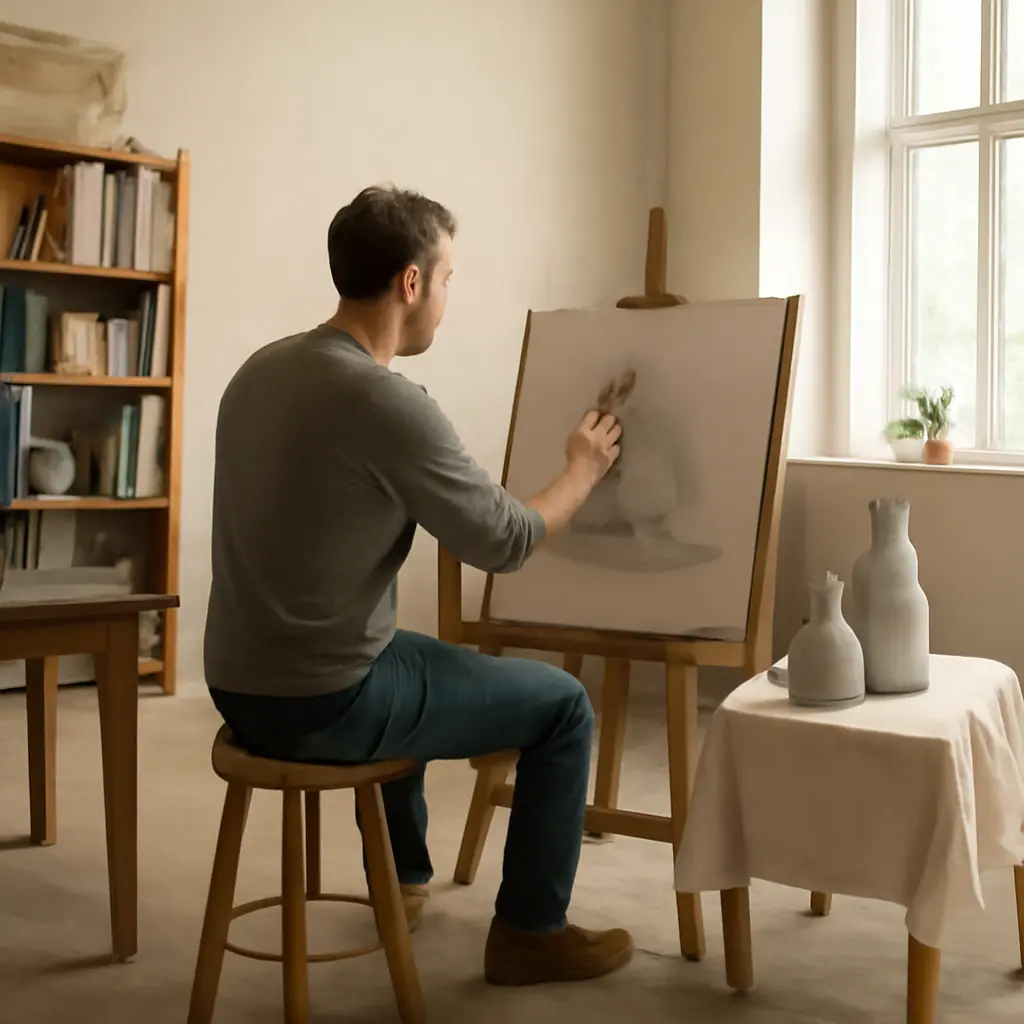
Artists Have Known This Secret About Focus for Centuries
Artists have long used a practical secret of focus: give attention a clear target, limit competing demands, and return to the work through deliberate practice. In modern psychology, this overlaps with selective attention, sustained attention, and flow—not a mysterious artistic gift, but a set of conditions and habits that help people concentrate. Research on expert performance and creativity supports parts of this approach, while also showing that breaks, constraints, and a supportive environment matter. From the focused studies of Renaissance workshops to today’s research on flow and distraction, the evidence offers useful lessons for artists and anyone doing demanding work.
Artists’ Focus Practices and the Science of Attention
Focus is the ability to direct mental resources toward relevant information or a chosen task while reducing the influence of competing inputs. The American Psychological Association describes attention as the focusing of awareness on selected aspects of the environment or experience. For artists, this can mean attending closely to proportion, color, rhythm, sound, language, or a single stage of a larger project.
The broader importance is measurable. A 2009 study by Gloria Mark and colleagues at the University of California, Irvine, found that office workers spent an average of about 11 minutes on a task before being interrupted or switching to another task; after an interruption, returning to the original task took about 25 minutes on average. That study examined workplace information work, not art-making, so its figures should not be treated as a universal estimate. It nevertheless illustrates why protecting attention can matter when a task requires continuity.
How Deliberate Attention Supports Artistic Work
Deliberate attention is the purposeful allocation of concentration to a defined activity. Psychologist and researcher Mihaly Csikszentmihalyi defined flow as a state of deep involvement in an activity, typically associated with clear goals, immediate feedback, and a balance between challenge and skill. Flow is related to focus, but it is not simply another word for concentration: it describes a broader experience of absorption and engagement.
For artists, deliberate attention can take several forms: sustained attention over a work session, selective attention to a particular feature, and focused practice aimed at improving a specific skill. These forms often work together. A painter may sustain attention through a session, selectively inspect a shadow’s value, and practice brush control through repeated studies.
Sustained attention: staying with the task
Sustained attention is the capacity to maintain engagement with a task over time. In studio practice, it is supported by making the next action concrete—such as sketching a set of thumbnails or mixing a limited palette—rather than setting only a vague goal like “make progress.” A clear next step reduces the effort needed to decide what to do whenever attention wanders.
Sustained attention does not mean working without pause. Research on rest and performance suggests that breaks can help people recover from prolonged effort, although the best timing and length depend on the person and task. A 2011 study by Alejandro Lleras and Atsunori Ariga found that brief diversions from a repetitive task helped participants maintain performance over time. Because the experiment used a simple laboratory task, it does not establish one ideal break schedule for artists; it does support the idea that attention can benefit from occasional renewal.
Selective attention: noticing what matters
Selective attention means prioritizing some information while filtering out other available information. Artists use it when they isolate a shape, listen for a particular instrument, track a character’s motivation, or judge the relationship between foreground and background. The practice is not merely looking harder: it involves choosing a useful question that guides perception.
A practical example is the “squint test” used in drawing and painting. Softening visual detail makes large masses of light and dark easier to compare, helping the artist temporarily ignore texture and small edges. Similar constraints appear in music, where a performer may practice a passage slowly, and in writing, where an editor may review only sentence structure before considering word choice. Each method narrows attention to a relevant layer of the work.
Deliberate practice: focus with feedback
Deliberate practice is structured effort directed at improving a specific aspect of performance, usually with feedback and opportunities to correct errors. In their 1993 research on expert performance, K. Anders Ericsson, Ralf Krampe, and Clemens Tesch-Römer described practice designed to improve performance rather than merely repeat familiar activity. For an artist, that might mean studying perspective with targeted exercises instead of producing finished work alone.
Practice and talent should not be treated as a simple equation. A 2014 meta-analysis by Brooke Macnamara, David Hambrick, and Frederick Oswald found that deliberate practice accounted for 21% of the variance in performance across the music studies included in their analysis, with the proportion differing by domain. The finding indicates that practice matters, but it does not explain all differences in achievement. Instruction, prior experience, opportunity, health, motivation, and other factors also shape development.
Why Constraints and Studio Rituals Can Help Focus
A constraint is a chosen limit that reduces the number of decisions involved in a task. Artists have used constraints in many forms: a restricted palette, a fixed meter, a small set of materials, a sonnet structure, or a timed drawing exercise. Constraints do not guarantee creativity, but they can make a task more manageable by giving attention a defined problem to solve.
Studio rituals serve a related purpose. Setting out tools, choosing a single project, and beginning with a familiar warm-up can mark the transition from preparation to work. These actions are not evidence of a special neurological shortcut; rather, they reduce avoidable decisions and provide consistent cues. The useful ritual is the one that helps an individual begin without becoming an elaborate task of its own.
Single-tasking and a prepared workspace
Single-tasking means keeping one primary activity in view instead of repeatedly switching among unrelated tasks. A prepared workspace supports it by making needed materials accessible and limiting obvious interruptions. For digital work, this might include closing unrelated tabs, silencing nonessential alerts, and keeping reference material in one organized place.
The evidence on task switching cautions against assuming that multitasking is cost-free. In a 2001 study, Joshua Rubinstein, David Meyer, and Jeffrey Evans found that switching between tasks can impose time costs, especially when tasks are complex or unfamiliar. The study does not mean every interruption ruins creative work; collaboration, research, and revision sometimes require switching. It does suggest that frequent, unnecessary switching can make demanding work less efficient.
Time blocks, warm-ups, and realistic goals
A time block is a planned period reserved for one kind of work. Some artists use a short warm-up before a longer session, while others divide work into cycles with breaks. There is no single scientifically established schedule that suits everyone. The practical test is whether the arrangement helps the artist start, sustain effort, and return after interruptions without sacrificing sleep or recovery.
Goals are most helpful when they describe an action under the artist’s control. “Revise the opening scene for 30 minutes” is more actionable than “write a brilliant scene.” A modest, specific goal also makes feedback easier: the artist can assess whether the planned action happened and decide what to do next.
Flow, Creativity, and the Limits of the Focus Myth
Flow can make artistic work feel unusually absorbed, but it should not be treated as a requirement for valuable work. Csikszentmihalyi’s model emphasizes clear goals and feedback, alongside a challenge level that is neither overwhelming nor trivial. Artists may also create effectively while uncertain, interrupted, or working through routine revisions. Focus is a useful condition for some stages of art-making, not a measure of artistic worth.
Creativity also involves exploration and evaluation. A 2015 study by Roger Beaty and colleagues examined brain networks associated with creative thinking and found evidence of interaction between networks linked to spontaneous thought and executive control. The result is consistent with the idea that creativity can involve both generating possibilities and evaluating them. It does not mean that a specific brain state guarantees a creative result.
Focused work and incubation
Incubation is a pause from active work on a problem during which useful ideas may later emerge. In a 2009 meta-analysis, Sio and Ormerod reviewed experimental research on incubation and found that taking a break from a problem can, under some conditions, improve later problem-solving. Effects vary with the task and the kind of break; the findings do not support the claim that every distraction is beneficial.
For practice, this means artists can alternate concentrated effort with intentional distance. After working through a difficult passage or composition, a walk, a meal, or a different low-demand activity may help create perspective. Recording the next step before pausing can make it easier to resume, while avoiding the assumption that waiting alone will solve the problem.
Attention is not a substitute for wellbeing
Concentration depends partly on conditions outside the work itself. Sleep, stress, pain, caregiving responsibilities, disability, and financial pressure can all affect a person’s ability to focus. Advice to eliminate every distraction may be unrealistic or unfair when the barriers are structural rather than a matter of willpower.
A sustainable approach treats rest and accessible working conditions as part of creative practice. The National Sleep Foundation recommends that adults generally obtain at least seven hours of sleep per night, while individual needs vary. Sleep recommendations are not a direct measure of artistic ability, but adequate rest supports general health and can make sustained mental effort more manageable.
A Practical Focus Routine for Artists
A focus routine should be simple enough to repeat and flexible enough to fit the work. The following sequence combines a defined target, a manageable work period, and a planned return point without prescribing one universal schedule.
- Choose one specific task, such as blocking in large color shapes or revising one scene.
- Prepare the tools and references needed, and reduce avoidable interruptions where practical.
- Work for a period suited to the task and your circumstances; take a short break if attention noticeably declines.
- Use feedback to identify one concrete adjustment rather than judging the entire project at once.
- Before stopping, write down the next action so returning to the work is easier.
For example, a watercolorist might spend one session comparing value relationships in a small study, take a break, and then decide whether the composition needs a change. A musician might isolate a difficult four-bar passage, practice it slowly, and return to the full piece after receiving feedback. In each case, attention is directed by a manageable question rather than by pressure to produce a masterpiece in one uninterrupted sitting.
Conclusion: Focus Is a Practice, Not a Secret Superpower
Artists’ focus practices—sustained attention, selective attention, deliberate practice, constraints, and planned breaks—offer a practical way to approach complex work. Research on interruptions, task switching, deliberate practice, flow, and incubation supports some parts of this tradition, while emphasizing that results vary and that focus alone does not explain creative achievement.
The broader lesson is to build conditions that make meaningful attention more possible: define the next step, limit unnecessary switching, seek useful feedback, and allow time for rest and reconsideration. Choose one small change to test in your next creative session, then keep what genuinely helps. For further reading, explore the work of Mihaly Csikszentmihalyi on flow and the research of Ericsson and colleagues on deliberate practice.
Sources: American Psychological Association, APA Dictionary of Psychology, “attention”; Mark, Gudith, and Klocke, The Cost of Interrupted Work: More Speed and Stress, 2008 ACM SIGCHI Conference on Human Factors in Computing Systems, https://doi.org/10.1145/1357054.1357072; Csikszentmihalyi, Flow: The Psychology of Optimal Experience, Harper & Row, 1990; Ariga and Lleras, Brief and rare mental “breaks” keep you focused: Deactivation and reactivation of task goals preempt vigilance decrements, Cognition, 2011, https://doi.org/10.1016/j.cognition.2010.12.007; Ericsson, Krampe, and Tesch-Römer, The Role of Deliberate Practice in the Acquisition of Expert Performance, Psychological Review, 1993, https://doi.org/10.1037/0033-295X.100.3.363; Macnamara, Hambrick, and Oswald, Deliberate Practice and Performance in Music, Games, Sports, Education, and Professions: A Meta-Analysis, Psychological Science, 2014, https://doi.org/10.1177/0956797614535810; Rubinstein, Meyer, and Evans, Executive Control of Cognitive Processes in Task Switching, Journal of Experimental Psychology: Human Perception and Performance, 2001, https://doi.org/10.1037/0096-1523.27.4.763; Beaty et al., Default and Executive Network Coupling Supports Creative Idea Production, Scientific Reports, 2015, https://doi.org/10.1038/srep10964; Sio and Ormerod, Does Incubation Enhance Problem Solving? A Meta-Analytic Review, Psychological Bulletin, 2009, https://doi.org/10.1037/a0014212; National Sleep Foundation, How Much Sleep Do You Really Need?, https://www.thensf.org/how-many-hours-of-sleep-do-you-really-need/.