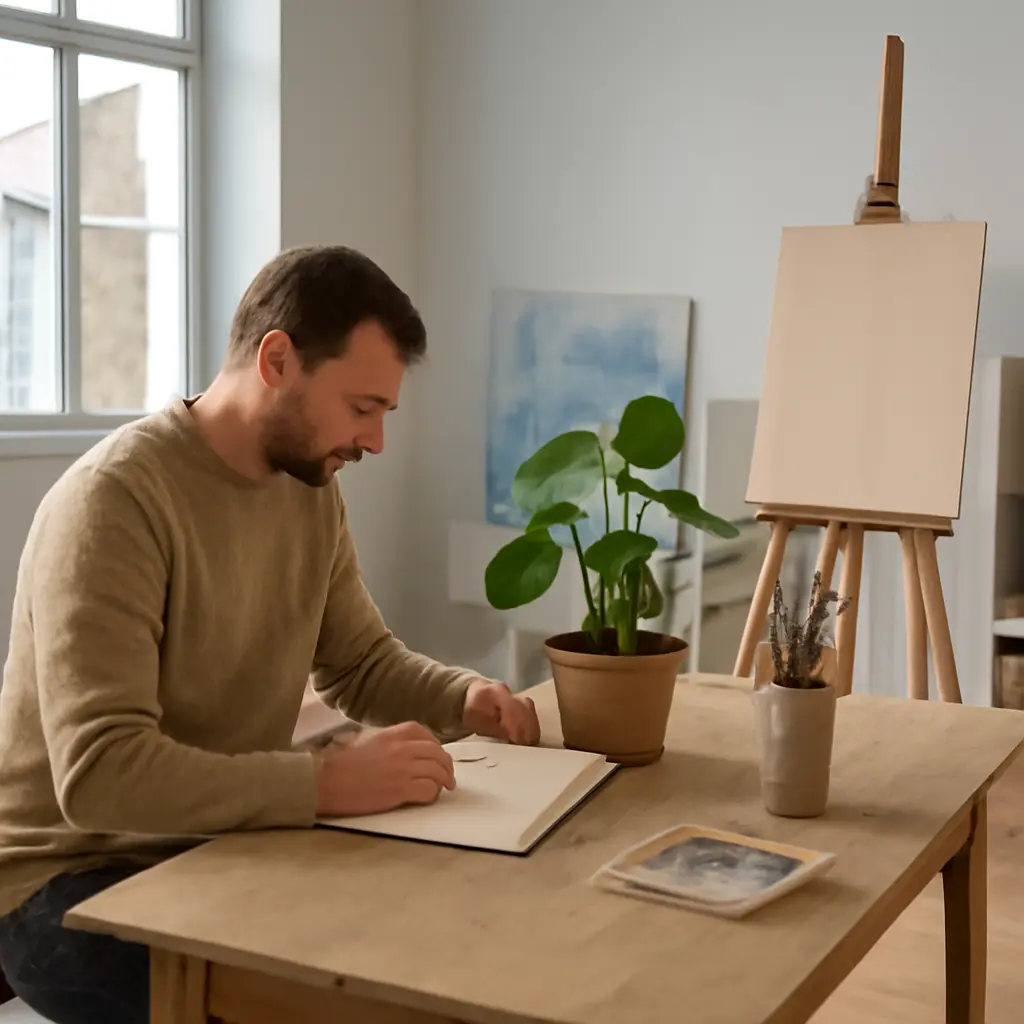
Drawing for relaxation how sketching rewires your brain and reduces stress
Drawing for relaxation is a simple practice with measurable potential: focusing on lines, shapes, and color can encourage present-moment attention, provide a break from rumination, and ease short-term stress. Research does not show that sketching “rewires” the brain in a guaranteed or permanent way, but studies of visual art-making suggest it can affect mood and stress-related processes. This article explains how drawing may support relaxation, what researchers have found, which sketching practices are useful, and how to begin without treating art as a test of talent.
Drawing for relaxation and the brain’s stress response
Drawing for relaxation means making images for the experience of making them, rather than for a polished result. It can include free sketching, doodling, coloring, observational drawing, and repeated patterns. These activities engage attention and visual-motor coordination; when they feel absorbing, they may help shift attention away from worries. That is a plausible route to temporary calm, not proof that every drawing session changes brain structure or treats a mental-health condition.
A frequently cited 2016 study in Art Therapy by Girija Kaimal, Kendra Ray, and Juan Muniz measured cortisol, a hormone associated with stress, before and after 45 minutes of art-making. Among 39 adults, cortisol levels decreased in 75% of participants. The study included different art materials and was not a trial of sketching alone, so its findings support art-making broadly rather than proving a specific effect from drawing. Its small sample and short timeframe also limit what can be concluded.
The relevance is practical: drawing is inexpensive, portable, and adaptable to different abilities. A sketchbook and pencil can create a low-pressure opportunity to pause. The most defensible expectation is that drawing may help some people feel calmer in the moment; effects vary, and it should not replace professional care when that is needed.
How drawing engages attention and supports relaxation
There is no single scientific definition of “brain rewiring” that applies to a relaxing sketch. In neuroscience, lasting brain change is generally discussed as neuroplasticity: the nervous system’s capacity to change with experience. Practicing a skill can strengthen relevant patterns of activity over time, but a short, casual drawing session has not been shown to produce a specific, lasting brain change. For relaxation, it is more accurate to describe drawing as an activity that can organize attention and influence immediate emotional experience.
Focused attention and a break from rumination
Focused attention is the act of directing awareness toward a chosen task. While sketching, a person might notice the curve of a mug, the pressure of a pencil, or the changing edge of a shadow. This sensory focus can interrupt repetitive thinking temporarily, much as other absorbing activities do. It is not a guaranteed distraction, and difficult thoughts may remain, but a simple visual task can offer a manageable point of attention.
A sense of absorption, without a performance goal
Absorption describes becoming engaged in an activity. Drawing may feel more relaxing when the goal is exploration rather than producing an impressive picture. The distinction matters: judging every line against an ideal can create pressure, while making marks freely may support a calmer experience. A useful prompt is to draw one object for five minutes without erasing, correcting, or showing the page to anyone.
Stress measures and what they do—and do not—show
Stress can be assessed through self-reports, physiological measures such as cortisol, or both. In the Kaimal, Ray, and Muniz study, the decrease in cortisol after art-making is evidence of a short-term physiological change in many participants. It does not establish that drawing alone caused the change, that participants felt less stressed in every respect, or that the benefit lasts. Researchers also emphasize that individual responses to creative activities differ.
Relaxing drawing practices and their distinct benefits
Different forms of drawing place attention in different ways. Choosing among them can make the activity easier to sustain, especially for beginners. These approaches are not clinical treatments; they are low-stakes ways to experiment with attention, sensory experience, and creative expression.
Doodling and repetitive patterns
Doodling is informal mark-making, often done without a fixed plan. Repeating circles, waves, grids, or spirals can give the hands a steady task and reduce the pressure to invent a complete image. Doodling can be especially accessible during a short break, though it may not suit everyone—some people find unstructured activity frustrating rather than calming.
Observational sketching
Observational sketching means drawing from something visible, such as a plant, cup, or view from a window. It encourages close looking: noticing proportions, edges, and light instead of relying on memory or assumptions. The purpose can be attention rather than accuracy. Try sketching a familiar object in broad shapes first, then add only details that catch your eye.
Coloring and simple guided drawing
Coloring and guided drawing offer structure through outlines, prompts, or step-by-step instructions. Structure can help people who feel stuck when facing a blank page. A 2017 randomized study by Girija Kaimal and colleagues compared coloring, free drawing, and pattern-based drawing in 66 adults; all groups showed reduced anxiety after the activity. Because the study measured immediate outcomes in a particular setting, it does not establish that one method is best for everyone or that results persist over time.
Building a simple, sustainable sketching routine
A relaxing routine should be easy to start and easy to stop. There is no evidence-based minimum number of minutes that guarantees stress relief. Instead, begin with a brief session and notice whether it helps. If drawing increases frustration or self-criticism, change the prompt, use a more guided activity, or choose another form of rest.
- Choose a comfortable place and keep basic materials nearby: paper and any pen, pencil, or coloring tool.
- Set a modest intention, such as noticing shapes or making marks for five to ten minutes, rather than finishing a picture.
- Draw a simple subject or repeat a pattern. Let imperfections remain unless correcting them feels enjoyable.
- Pause afterward and check in: Do you feel more settled, unchanged, or more tense? Use that observation to decide what to try next.
For a visual comparison, an article graphic could show a “drawing options” chart with activity, structure, and suggested starting point: free doodling (low structure), observational sketching (one visible subject), and guided coloring (high structure). Such a chart can help readers select an approach without implying that any category has a proven universal effect.
Conclusion: drawing as a small tool for everyday calm
Drawing for relaxation can engage focused attention, invite absorption, and offer a temporary break from rumination. Studies of art-making have reported short-term reductions in cortisol or anxiety for many participants, but the evidence does not establish that sketching permanently rewires the brain or works equally well for everyone. Doodling, observational sketching, coloring, and guided drawing each provide different ways to begin.
Try a short, nonjudgmental session and pay attention to your own response. Treat the page as a place to explore, not a measure of artistic ability. For persistent or overwhelming stress, consider seeking support from a qualified health professional; drawing can complement care, but it is not a substitute for it.
Sources: Kaimal, Girija; Ray, Kendra; and Muniz, Juan, Reduction of Cortisol Levels and Participants’ Responses Following Art Making, Art Therapy: Journal of the American Art Therapy Association, 2016, https://doi.org/10.1080/07421656.2016.1166832; Kaimal, Girija; Herrera, Natalia; and Terry, Linsey, Examining the Impact of Brief Creative Interventions on Psychological and Physiological Outcomes, Art Therapy: Journal of the American Art Therapy Association, 2017, https://doi.org/10.1080/07421656.2017.1300826