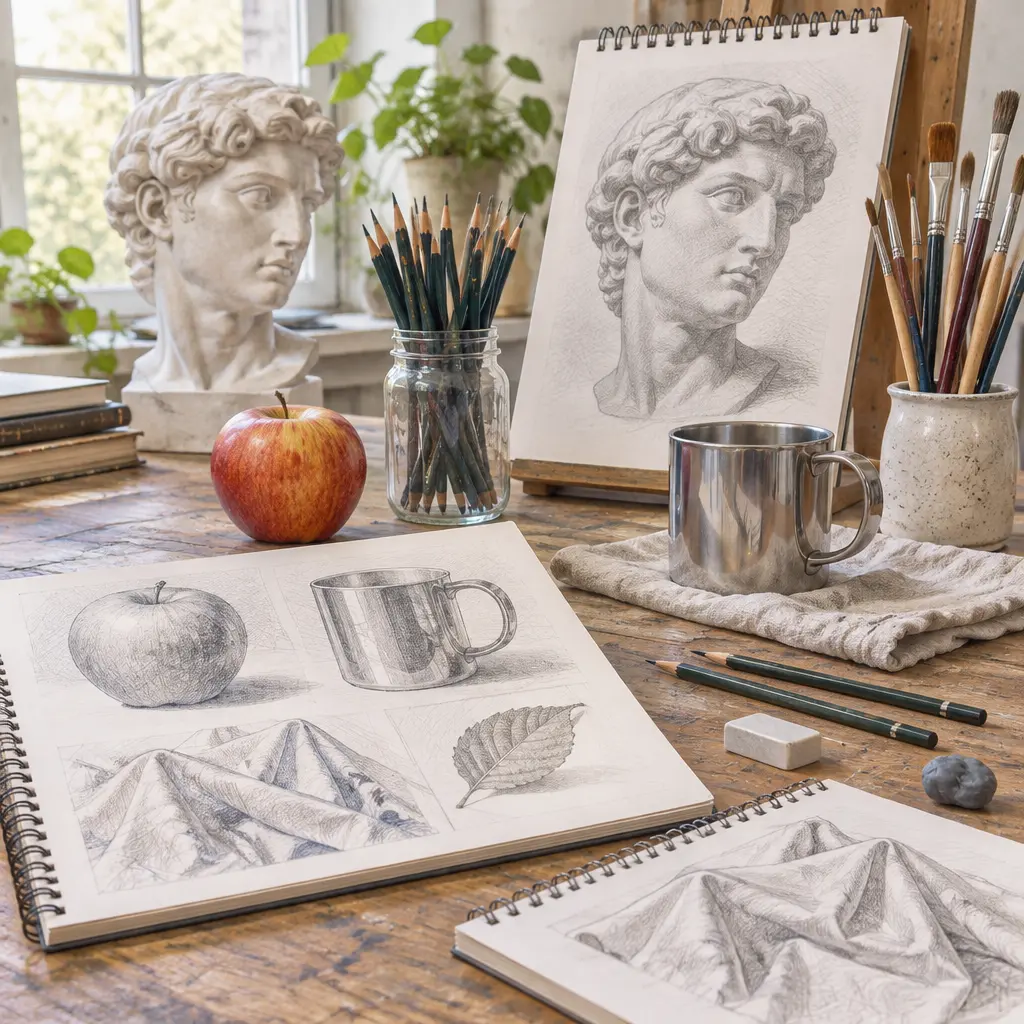
Drawing Skill Development Prioritizing Observational Accuracy Over Stylistic Imitation
Observational drawing is the practice of representing a subject by looking closely at what is actually visible rather than relying mainly on memory, symbols, or another artist’s style. Developing this skill means learning to compare proportions, angles, shapes, values, and spatial relationships against the subject and correcting mismatches. Research on visual perception and drawing suggests that accurate representation depends not simply on “good eyes,” but on deliberate looking, measurement, and repeated feedback. This article explains how observational accuracy differs from stylistic imitation, outlines practical training methods and ways to assess progress, and connects drawing practice to research on perception and expertise.
Observational Accuracy as a Drawing Skill
Observational accuracy is the degree to which a drawing reflects the visible relationships in a reference subject. It does not require photographic detail: a simplified drawing can be accurate if its major proportions, angles, contours, and value relationships are convincing. The key distinction is between drawing what is observed and drawing what the artist expects an object to look like. A familiar eye, for example, may be represented with a conventional almond shape even when the particular eye being studied is narrower, tilted, or partly obscured.
Psychologist and art educator Betty Edwards popularized structured exercises for improving visual attention in Drawing on the Right Side of the Brain. Her approach encourages learners to attend to edges, spaces, relationships, and light rather than defaulting to object labels. The broader principle is consistent with perceptual-learning research: practice can improve performance when it directs attention toward relevant differences and provides opportunities to compare judgments with outcomes. Observational accuracy is therefore trainable, but it grows through focused practice rather than sheer drawing volume alone.
Proportion and Measurement
Proportion is the relative size of parts within a subject or between the subject and its surroundings. Artists can check it by comparing widths and heights, using a pencil held at arm’s length as a simple measuring tool, or identifying alignments between landmarks. For a portrait, useful comparisons include the distance between the eyes, the width of the nose relative to the mouth, and the height of the head relative to its width. These are not fixed formulas; they are hypotheses to test against the individual model.
Measurement is most useful when it remains comparative. If the head appears too wide, the artist can compare its width with its height and with the spacing of facial features, then revise the drawing. Repeated checks reduce the influence of visual memory, which tends to replace specific forms with familiar categories. A practical exercise is to make a few light marks for the outer boundaries and major landmarks before committing to details.
Angles, Contours, and Negative Space
Contour describes the visible boundary or internal edge of a form; angle describes the direction of a line or plane. Negative space is the shape of the area around or between objects. These categories help artists notice structure without depending on names such as “hand,” “chair,” or “tree.” A gap between a bent arm and torso, for example, may be easier to compare accurately than the arm itself because its shape can be treated as a distinct two-dimensional form.
A useful drill is to draw the major angles of a subject as straight lines first, then refine them into curves. Another is to sketch only the negative spaces around an object. Both exercises make errors in tilt, spacing, and silhouette more visible. They also help distinguish observed contours from symbolic outlines that may seem plausible but do not match the particular subject.
Value and Light Relationships
Value is the relative lightness or darkness of a mark. Observational drawing uses value grouping to describe illumination, shadow, and form. Instead of immediately shading every surface, artists can first sort the scene into a few broad families: light, midtone, and shadow. The National Gallery of Art’s educational resources on looking at art emphasize close attention to visual elements such as line, shape, and light; these are useful categories for describing what a drawing needs to communicate.
Squinting at a subject or viewing it in grayscale can help simplify complex information into larger value masses. The goal is not to copy every subtle transition, but to preserve the most important contrast relationships. A still life with a dark object against a light background, for instance, may read clearly even with limited detail if the silhouette and value separation are correctly observed.
Observational Practice Builds Accuracy Through Feedback
Practice improves observational drawing when it includes a cycle of looking, making a mark, comparing that mark with the subject, and revising. This is different from repeating a familiar drawing routine without checking whether the result matches what is seen. In Peak, psychologist Anders Ericsson and science writer Robert Pool describe deliberate practice as structured work focused on specific aspects of performance, with feedback and opportunities to correct errors. Their account concerns expertise broadly, rather than drawing alone, but its principles offer a useful framework for art training.
There is no single, well-established statistic that predicts how many hours an individual needs to become an accurate observational artist. Skill depends on the learner, task, instruction, and quality of practice. It is more reliable to track specific outcomes—such as proportion errors, time spent checking relationships, or the ability to draw unfamiliar subjects—than to treat total hours as a guarantee.
Short Exercises With a Defined Target
A targeted exercise isolates one visual problem so that the learner can notice it clearly. For example, a ten-minute contour study can focus on the direction and continuity of edges, while a small tonal study can focus only on three value groups. A timed gesture sketch can prioritize overall movement and weight rather than finished detail.
A balanced practice session might include a quick warm-up, a focused study of one category, and a longer drawing that combines several categories. Keeping the objective narrow makes review more useful: instead of asking whether the drawing “looks good,” the artist can ask whether the main axis, silhouette, or shadow shape is more accurate than in the previous attempt.
Comparison, Error Checking, and Revision
Feedback turns an impression into information. Artists can compare their drawing and subject by checking overall height-to-width ratios, measuring landmark distances, flipping the drawing in a mirror, or taking a brief photograph of the work. These checks can reveal distortions that become difficult to notice after staring at a drawing for a long time. The reference should remain visible during the process whenever the purpose is observational study.
Revision is not evidence that the first attempt failed; it is a central part of learning. A useful routine is to identify the largest mismatch first, correct it, and then reassess smaller relationships. This prevents detail from consuming time while fundamental structure remains unresolved. Teachers can support this process by giving specific feedback—for example, “the far edge is steeper” rather than “make it look more realistic.”
Progress Measures and a Sample Practice Log
Progress can be measured through repeated drawings of comparable subjects, dated sketches, and written notes about errors noticed. A practical log might record the subject, duration, main objective, one successful observation, and one relationship to check next time. Over several weeks, the artist can look for patterns: perhaps silhouettes improve quickly while value grouping needs more deliberate study.
A simple comparison chart could list sessions across the horizontal axis and selected criteria—such as proportion, angle, contour, and value grouping—on the vertical axis. The scores should be treated as personal tracking tools, not standardized measures of artistic ability. The most useful evidence is whether drawings become more responsive to new references and whether the artist can identify and correct errors more independently.
Stylistic Imitation and Observational Drawing Serve Different Goals
Stylistic imitation is the study or adoption of recognizable visual choices, such as simplified anatomy, expressive line, limited palettes, or particular forms of exaggeration. It can be valuable for learning how images are constructed, but it is not identical to observing a subject directly. A learner copying a cartoon eye may reproduce its design accurately while becoming less attentive to the shape of an eye in a live model.
The distinction is about sequence and purpose, not a requirement to reject style. Observational study can build a flexible understanding of form; style can then transform that understanding through selection, simplification, or exaggeration. Art historian Ernst Gombrich, in Art and Illusion, examined how artistic representation involves conventions and expectations rather than a simple mechanical transfer of vision. His work helps explain why learning to see and choosing how to depict are related but separate decisions.
Copying a Style as a Learning Exercise
Copying a historical or contemporary artwork can teach line economy, composition, mark-making, and color relationships. To keep the exercise informative, learners can identify which choices belong to the artist’s style and which describe the depicted subject. They should also distinguish copying an existing artwork for private study from presenting another artist’s work as their own; attribution and copyright considerations matter when sharing or publishing studies.
A productive sequence is to observe a subject independently, make a study focused on its structure, and then make a second version using selected stylistic principles. Comparing the two reveals what the style changes: perhaps it simplifies shadow shapes, enlarges the hands, or uses a uniform contour. This turns imitation into analysis rather than a substitute for seeing.
Using Reference Without Becoming Dependent on It
Reference is a tool for checking visual information, not a barrier to creativity. Working from life offers changing light, depth, and the possibility of viewing an object from different angles. Photographs provide a stable image that can be revisited, though they flatten three-dimensional space and may distort proportions depending on lens and camera position. Memory drawing, by contrast, tests what the artist has understood and retained.
Artists can combine these approaches: observe a subject from life, make a short study, then draw it from memory and compare the result with the original. The differences identify which features were understood and which were replaced by assumptions. This method supports both accurate observation and independent visual thinking.
A Practical Framework for Developing Observational Accuracy
A structured routine can help beginners and experienced artists alike. The sequence below moves from broad relationships to detail so that local marks remain connected to the overall subject.
- Choose a subject with clear lighting and a manageable level of complexity.
- Observe the overall height, width, tilt, and placement before drawing details.
- Mark major landmarks and compare their distances and alignments.
- Check the silhouette, angles, and negative spaces.
- Group values into broad light and shadow areas.
- Compare the drawing with the subject and correct the largest mismatch.
- Record one lesson and repeat the study under a changed condition, such as a new angle or lighting setup.
Real-world practice can begin with ordinary objects: a mug, shoe, plant, or hand. These subjects provide varied contours and overlapping forms without requiring specialized equipment. A learner might draw the same mug from three viewpoints, first focusing on its ellipse and axis, then on negative space, and finally on value. The exercise shows how changing the observation target can reveal different kinds of error.
For portraits or complex figures, working from general to specific is especially important. Begin with the overall head or body mass, then place large landmarks, and only afterward develop features and surface detail. This approach reduces the risk of producing individually polished features that do not fit the subject’s proportions or pose.
Conclusion: Make Observation the Foundation, Not a Limitation
Observational accuracy is a learnable drawing skill built from proportion checking, attention to angles and negative spaces, value comparison, and repeated feedback. Focused practice is more informative than unexamined repetition, while progress logs and targeted comparisons help artists identify what is improving. Stylistic imitation remains useful for studying visual decisions, but it serves a different purpose from directly examining a subject.
To develop stronger drawing skills, choose one subject today and make two short studies: one focused on its silhouette and proportions, the other on its value groups. Compare both with the reference, note the largest discrepancy, and use that observation to guide the next session. For further reading, consult Betty Edwards on visual-attention exercises, Anders Ericsson and Robert Pool on deliberate practice, and Ernst Gombrich on representation and artistic conventions.
Sources: Betty Edwards, Drawing on the Right Side of the Brain, TarcherPerigee, 2012; Anders Ericsson and Robert Pool, Peak: Secrets from the New Science of Expertise, Houghton Mifflin Harcourt, 2016; Ernst H. Gombrich, Art and Illusion: A Study in the Psychology of Pictorial Representation, Princeton University Press, 1960; National Gallery of Art, “Learning Resources,” https://www.nga.gov/learn.html; National Academies of Sciences, Engineering, and Medicine, How People Learn II: Learners, Contexts, and Cultures, National Academies Press, 2018, https://doi.org/10.17226/24783.