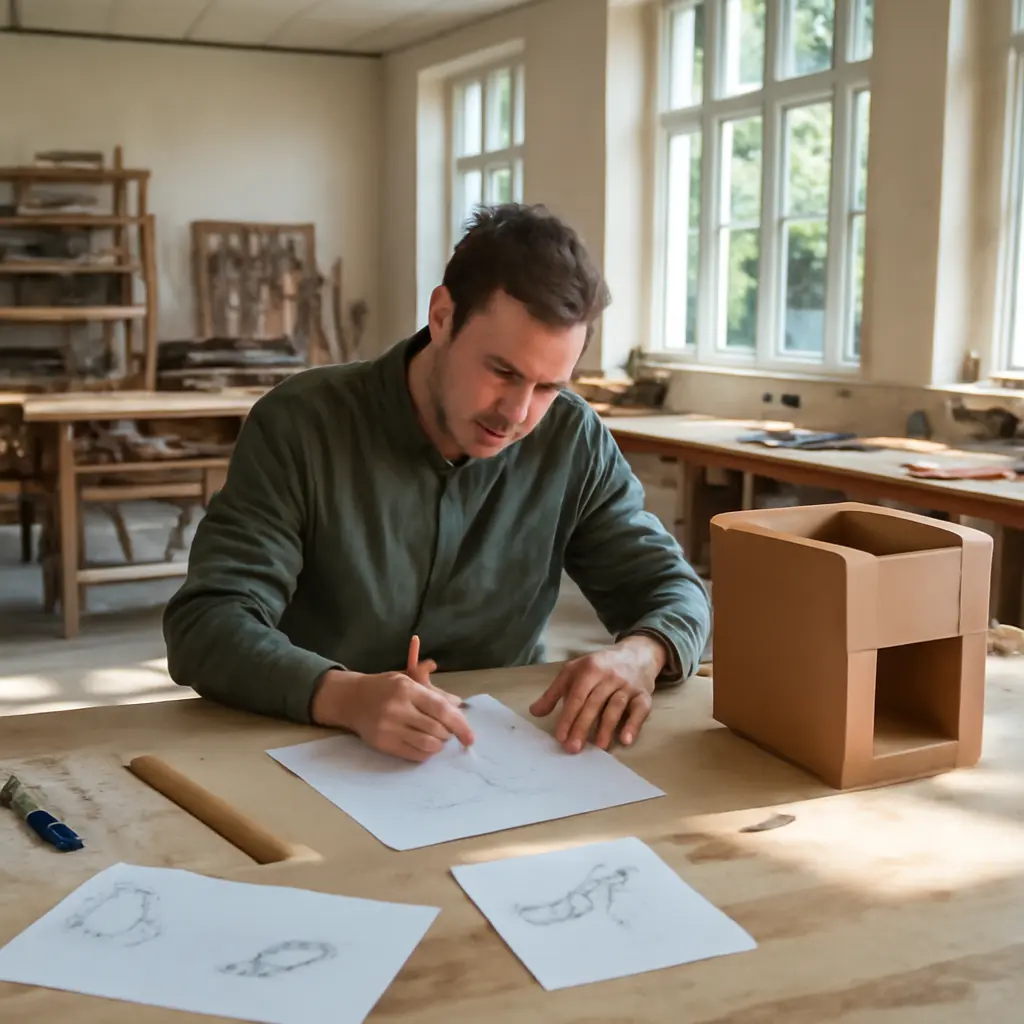
Abstract thinking expands what your hand can actually create
Abstract thinking is the ability to work with ideas, patterns, and possibilities that are not limited to what is immediately visible or tangible. In creative work, it helps people imagine alternatives, simplify complex problems, and turn concepts into physical results. Research on divergent thinking and design practice suggests that generating and testing multiple ideas can widen the range of solutions a person can make. This article explains how abstraction supports creative problem-solving, connects imagination to practical skills, and shows how artists, designers, and makers can use it without losing touch with real-world constraints.
Abstract Thinking Expands Creative Possibility
Abstract thinking means reasoning beyond immediate objects and experiences. It includes recognizing relationships, imagining hypothetical situations, and considering what something could become rather than only what it is now. The American Psychological Association describes abstract thinking as thinking in terms of general principles or concepts rather than specific instances. In making, this mental shift allows a person to treat a material, tool, or problem as a starting point for several possible outcomes.
The practical value is not simply that imagination produces more ideas. Abstract thinking helps makers reorganize what they know: a scrap of wood may suggest a joint, a shadow may suggest a composition, and a recurring inconvenience may suggest a new product. The National Endowment for the Arts’ research on arts participation and learning discusses how creative activities can engage skills such as observation, experimentation, and problem-solving. These abilities matter across visual art, craft, engineering, writing, and everyday repair.
How Abstract Thinking Expands Creative Problem-Solving
Creative problem-solving is the process of defining a challenge, producing possible responses, and evaluating or refining them. Abstract thinking expands this process by allowing a maker to separate a problem from its first apparent solution. Instead of asking only, “How do I build this exact object?” the maker can ask, “What function must it perform?” or “What other forms could deliver that function?” This reframing connects abstract reasoning with divergent thinking, analogy, and design iteration.
Divergent Thinking and Idea Generation
Divergent thinking is the generation of multiple possible responses to an open-ended question. It is a close companion to abstract thinking because both encourage people to move beyond a single literal answer. In a classic study, J. P. Guilford helped establish divergent production as an important area of creativity research, distinguishing it from convergent thinking, which narrows options toward a solution. For a maker, divergent thinking might mean sketching ten possible lamp shapes before choosing one to prototype.
Generating alternatives is useful, but quantity alone does not guarantee quality. Ideas still need to be tested against purpose, material, safety, cost, and audience. A practical method is to separate the stages: first produce varied possibilities without judging each one, then select and develop the strongest options. This lets abstract exploration feed into concrete decisions instead of becoming an end in itself.
Analogical Thinking and Transfer
Analogical thinking uses a relationship from one domain to understand or solve a problem in another. A designer might borrow the branching structure of a tree to organize a support system, or use the folding behavior of a map as inspiration for a portable object. Research by Dedre Gentner and colleagues on structure-mapping theory describes analogy as a way of aligning relationships between situations, rather than merely noticing superficial similarities.
Analogy broadens what a person can make because knowledge becomes reusable. A sewing technique may inform a paper construction; a musical rhythm may shape a visual pattern; the way a hinge moves may suggest a feature in a digital interface. The strongest analogies transfer an underlying principle—such as balance, repetition, or controlled flexibility—rather than copying an unrelated appearance.
Reframing and Abstraction
Reframing means describing a challenge from a different perspective. It often begins by moving from a specific object to its purpose. If a person wants to make a better desk organizer, the abstract question might be how to make frequently used items visible and easy to reach. That broader statement allows solutions beyond a conventional tray, including a wall system, modular containers, or a stand designed around the user’s habits.
This approach resembles design methods that distinguish between a problem’s symptoms and its underlying needs. The Stanford d.school’s design-thinking resources emphasize understanding people and defining the problem before developing and testing ideas. Reframing therefore provides a bridge from abstract possibility to practical invention: it opens the design space while keeping the work connected to a real need.
How Abstract Thinking Becomes Something You Can Make
An idea becomes useful when it can be expressed, tested, and revised. Abstract thinking supports this transition by helping a maker move among concept, representation, and material. Sketches, models, notes, diagrams, and prototypes act as external supports for thought: they make an imagined relationship visible enough to inspect. The process is iterative, because contact with materials often reveals constraints or opportunities that were not apparent in the original idea.
Visualization, Sketching, and Modeling
Visualization is the mental or external representation of a possible form, action, or result. A quick sketch can make an abstract idea easier to compare, while a physical model can reveal scale, balance, movement, and assembly problems. In architecture and industrial design, drawings and prototypes are not merely records of finished thinking; they are tools for developing it.
For example, someone designing a compact reading light can sketch several arrangements of the base, arm, and shade, then make a rough model from inexpensive materials. The model tests whether the light reaches the page and whether the arm stays in position. This is a practical cycle: imagine, represent, observe, and revise. A chart or diagram of the cycle would show the process as a loop rather than a straight line, because each test can generate a new concept.
Material Exploration and Constraints
Materials are not passive carriers of an idea. Their weight, texture, flexibility, cost, and behavior influence what can be made. Abstract thinking helps makers see materials in terms of properties and possible functions, while hands-on experimentation checks whether those possibilities are realistic. A sheet of cardboard, for instance, can be treated not only as a flat surface but as a foldable structure, a mold, or a temporary joint.
Constraints can also support creativity by focusing attention. A limited budget, a small workspace, or a requirement to use reclaimed materials narrows some options while encouraging others. The key is to distinguish a productive constraint from an avoidable obstacle: a maker should explore alternatives, but also verify durability, accessibility, safety, and environmental impact before treating a promising prototype as a finished solution.
Iteration, Feedback, and Skill
Iteration is the repeated process of making, evaluating, and improving. It links abstract thinking to craftsmanship because ideas become more precise through encounters with real tools and materials. Feedback from users, peers, or measurements can reveal whether a creation works as intended. Instead of treating an imperfect first attempt as failure, a maker can use it as evidence about what to change next.
The National Academies’ report on learning and transfer explains that people apply knowledge more effectively when they understand underlying principles, not only isolated procedures. In creative practice, that means learning why a joint holds, why a composition feels balanced, or why a particular interface is easy to navigate. Understanding principles makes it easier to adapt skills to new materials and unfamiliar projects.
Where Abstract Thinking Makes a Real-World Difference
Abstract thinking is valuable wherever people must transform a need into a workable form. It supports artistic experimentation, product design, engineering, education, and everyday problem-solving. The same pattern appears in each setting: identify a purpose, imagine alternatives, represent an idea, test it, and refine the result.
Art and Craft
Artists and craftspeople often begin with a theme, emotion, or question rather than a complete object. They may translate a concept such as movement into line, repetition, texture, or form. A ceramic artist exploring “fragility,” for example, could use thin walls, uneven edges, or contrasting glaze to communicate the idea while still considering how the piece will be fired and handled. Abstraction gives the work conceptual range; craft skill makes that range tangible.
Product and Service Design
Designers use abstraction to identify the need behind a requested feature. A request for a larger button may reflect a deeper need for easier operation; a request for more storage may reflect a problem with access or organization. Considering the underlying task can lead to solutions that are simpler or more effective than the first proposal. The design-thinking process of research, ideation, prototyping, and testing provides a structured way to move from that insight to a usable result.
Education and Everyday Making
In education, abstract thinking helps learners connect particular examples to broader principles. A student who understands that a bridge distributes forces can apply that insight to a model made from paper or to a different engineering problem. In everyday life, the same capacity appears when someone adapts a repair method, repurposes an object, or reorganizes a space around how it is actually used.
These examples show why abstract thinking does not belong only to specialists. It is a learnable way of approaching questions. People can strengthen it by asking what a problem is really about, looking for patterns, borrowing principles from other fields, and making small tests before committing to a final version.
Conclusion: Turn Abstract Ideas into Practical Experiments
Abstract thinking expands what a person can make by opening up more ways to define a problem, connect ideas, and imagine outcomes. Divergent thinking generates options; analogy transfers useful patterns; reframing reveals needs beneath surface requests; and visualization, material testing, and iteration turn concepts into workable creations. Together, these practices make imagination more than speculation: they give it a path into the world.
To put the idea into practice, choose a small challenge, write down its underlying purpose, sketch several different solutions, and build a simple prototype. Seek feedback, observe what happens, and revise. The more often you move between ideas and experiments, the more confidently your hand can create what your mind has not yet seen.
Sources: American Psychological Association, APA Dictionary of Psychology, “abstract thinking,” https://dictionary.apa.org/abstract-thinking; Guilford, J. P., “Creativity,” American Psychologist, 1950, https://doi.org/10.1037/h0063487; Gentner, Dedre, “Structure-Mapping: A Theoretical Framework for Analogy,” Cognitive Science, 1983, https://doi.org/10.1207/s15516709cog0702_3; Stanford d.school, Design Thinking Bootleg, https://dschool.stanford.edu/resources/design-thinking-bootleg; National Academies of Sciences, Engineering, and Medicine, How People Learn II: Learners, Contexts, and Cultures, 2018, https://doi.org/10.17226/24783; National Endowment for the Arts, Arts Education and Social-Emotional Learning Outcomes Among K-12 Students, https://www.arts.gov/impact/research/publications/arts-education-and-social-emotional-learning-outcomes-among-k-12-students.