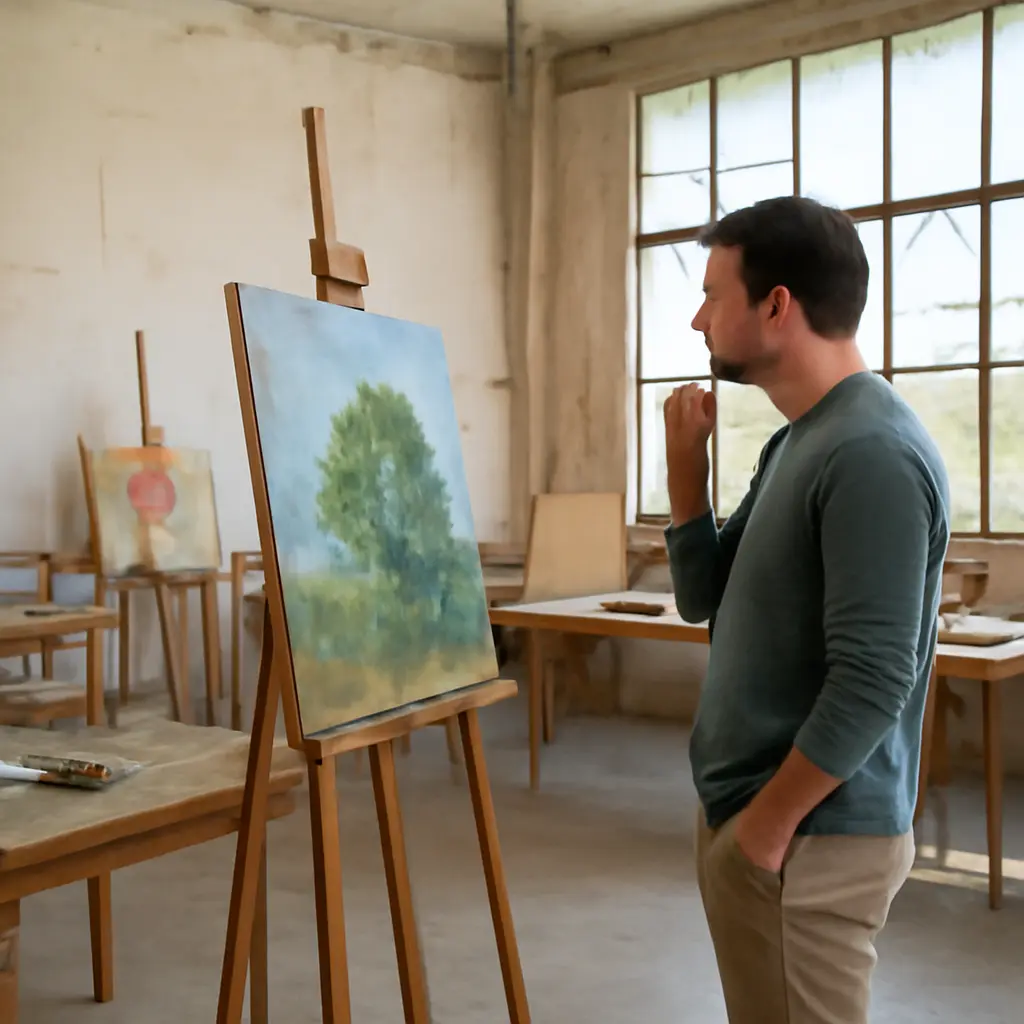
The messy middle of learning something new separates serious artists from hobbyists
Learning a new artistic skill means moving through a “messy middle”: the uncertain stretch after initial enthusiasm, when progress slows, mistakes accumulate, and practice stops feeling rewarding. Serious artists are not simply people who never struggle; they are people who keep working through that stage with deliberate practice, useful feedback, and realistic expectations. Research on expertise, learning, and creative work supports this distinction, while also showing why persistence alone is not enough: the quality and structure of practice matter. Understanding the learning curve, productive struggle, feedback, and sustainable routines can help artists—and hobbyists who want to grow—turn frustration into progress.
Deliberate Practice Defines the Artist’s Messy Middle
Deliberate practice is a focused form of training directed at improving specific aspects of performance. Psychologist K. Anders Ericsson and colleagues described it as effortful practice designed to improve performance, typically involving clear goals, concentration, feedback, and repeated refinement. It is different from merely spending time on an activity: an artist can draw, write, rehearse, or compose for hours without deliberately addressing the weaknesses that limit progress.
This distinction matters in the messy middle, when broad enthusiasm gives way to particular challenges: a painter struggles with value and composition, a musician with timing, or a writer with structure and revision. In a major review, Ericsson and colleagues argued that expert performance is built through sustained, structured practice rather than explained by innate talent alone. A 2014 meta-analysis by Brooke Macnamara, David Hambrick, and Frederick Oswald added an important qualification: deliberate practice is associated with performance, but its contribution varies by domain and does not explain every difference in achievement. Practice is powerful, not a guarantee.
Focused practice targets a specific weakness
Focused practice means choosing a manageable skill to improve, rather than attempting to fix everything at once. An illustrator might spend a session drawing objects from observation to strengthen proportion; a singer might isolate a difficult passage; a novelist might revise dialogue for clarity. The goal is to make the work challenging enough to reveal a gap, but not so broad that the learner cannot tell what to do next.
This approach reflects a wider learning principle: practice works best when the task and the desired improvement are clearly connected. The National Academies’ review of how people learn emphasizes that effective learning depends on prior knowledge, feedback, and the design of the learning environment. Artists can apply the same principle by keeping a practice log: record the skill attempted, the problem noticed, and one adjustment to test next time.
Repetition becomes useful when paired with reflection
Repetition builds familiarity, but repetition without evaluation can reinforce the same habits. Reflective practice adds a short review: What improved? What still feels unstable? What evidence supports that judgment? A musician can compare recordings from different weeks, while a visual artist can keep dated studies or revisit the same subject under similar conditions.
The bridge from repetition to reflection is feedback. Once artists can identify a specific difficulty, they can compare their work with a reference, ask a trusted instructor, or seek critique from peers. That comparison turns a vague feeling of “I’m not good enough” into a more useful question: “Which part of this piece should I work on next?”
Feedback and Productive Struggle Make Artistic Progress Visible
Productive struggle is the effort of working through a challenge that is difficult but still approachable with support, practice, or a change of strategy. In artistic learning, it may involve an awkward draft, a failed study, or a performance that exposes a technical weakness. Struggle is not automatically productive: without a clear goal or a way to respond, repeated frustration can become discouragement rather than learning.
Feedback helps make the struggle informative. In a widely cited 1998 review, educational researchers John Hattie and Helen Timperley described feedback as information about performance or understanding that can help close the gap between current and desired outcomes. Its usefulness depends on what it tells the learner and how it is delivered. “This is bad” provides little direction; “the focal point is unclear because the strongest contrast is in the background” identifies a problem that can be tested and revised.
Specific critique turns mistakes into information
A useful critique points to an observable feature of the work and offers a question or next step. For example, a writing group might note that a character’s choice is difficult to follow, while a dance teacher might identify where balance breaks down. Artists should distinguish feedback about the work from judgments about their identity: a weak passage does not mean someone is a weak writer, and an unfinished study is not a verdict on artistic potential.
Feedback is most effective when it arrives in time to influence the next attempt and is specific enough to act on. Hattie and Timperley’s framework distinguishes feedback about the task, the process, and self-regulation from general praise or personal judgments. Artists can use that distinction by asking reviewers questions such as, “Where does the composition lose focus?” or “Which revision would make the argument clearer?”
Failure and revision are part of the creative process
Failure in creative work is an outcome that does not yet meet the maker’s intention; revision is the process of using that result to make another attempt. The two belong together. A first draft can reveal that an idea lacks structure, just as a clay model can reveal a balance problem that was invisible in a sketch. Treating the attempt as evidence makes it easier to revise without interpreting every imperfection as proof of inability.
The creative process is rarely a straight line from idea to finished work. Graham Wallas’s influential account of creativity described stages that include preparation, incubation, illumination, and verification—an early framework, not a universal law. Its continuing value is the reminder that generating an idea and testing whether it works are different activities. The messy middle often contains both: exploration produces possibilities, while revision selects and strengthens them.
A Sustainable Routine Helps Artists Continue Through Plateaus
A learning plateau is a period when visible improvement slows or becomes hard to notice. It can occur because a learner has reached a more complex level, is repeating familiar exercises, or lacks a useful way to measure progress. A plateau is not proof that ability has stopped developing; it is a prompt to review the practice method, the challenge level, and the evidence being used to judge improvement.
Persistence is easier when practice is sustainable. In a 2006 study in Psychological Science, psychologist Phillippa Lally and colleagues examined how people formed habits through repeated behavior in everyday contexts. The time required for a behavior to become automatic varied substantially among participants; the study did not establish a universal “21-day” rule. For artists, the practical lesson is to build a repeatable routine that fits real life rather than expect motivation to remain constant.
Small, consistent sessions reduce reliance on motivation
A consistent session is a planned period of practice that is realistic enough to repeat. It might be twenty minutes of sketching after work, a daily warm-up before rehearsal, or two weekly blocks for drafting and revision. The exact schedule should match the artist’s goals and circumstances; regularity is useful because it creates repeated opportunities to practice, observe, and adjust.
Small sessions also make it easier to define a concrete task. Instead of “get better at painting,” an artist can plan to make three studies of reflected light. Instead of “write a novel,” a writer can draft one scene and mark the point where the character’s objective changes. A routine does not remove difficulty; it makes returning to difficulty more manageable.
Rest, variety, and reflection support continued learning
Rest and variation help keep practice sustainable. Repeating the same task indefinitely can lead to fatigue or narrow habits, while a deliberate change—studying a new reference, switching materials, or alternating technical drills with finished work—can expose skills in a different context. This should not be confused with constantly abandoning a difficult goal: variety works best when it supports the main learning objective.
Artists can also measure progress with more than a finished product. A portfolio of dated work, rehearsal recordings, revision notes, or a checklist of specific techniques can reveal changes that are hard to notice day by day. For instance, a beginner may not yet produce a polished portrait but may show clearer proportions and more controlled edges across successive studies. Tracking these smaller indicators helps separate genuine growth from momentary frustration.
Serious Artistic Commitment Is a Practice, Not a Status
The distinction between a serious artist and a hobbyist is not a judgment about worth, identity, or professional success. It is more useful to describe seriousness as a pattern of choices: setting intentions, practicing specific skills, seeking feedback, and returning to the work after setbacks. Hobbyists can adopt these habits, and professional artists can still experience uncertainty, avoidance, and plateaus.
Real-world practice illustrates this point. A community musician preparing for an ensemble audition may isolate difficult measures, record rehearsals, and adjust technique based on a teacher’s notes. A hobby photographer may use the same cycle by studying exposure, reviewing images, and testing changes on the next shoot. The scale of the ambition differs; the learning process can be remarkably similar.
Commitment is shown through choices that can be repeated
Commitment is not the same as working without rest or expecting every session to produce a masterpiece. It means maintaining contact with the craft through actions that can be sustained: finishing studies, reviewing mistakes, asking for critique, or returning to an unfinished draft. These behaviors turn an abstract wish to improve into a process that can be observed and adjusted.
This framing also protects the value of art made for pleasure. A hobby can be deeply meaningful without becoming a career, and commercial success is not a reliable measure of learning. The relevant question is not whether an artist has earned a particular label, but whether their chosen practice is helping them move toward the work and skills they value.
Conclusion: Use the Messy Middle as a Map for Growth
The messy middle is where artistic ambition meets the practical work of learning. Deliberate practice gives that work a focus; feedback and productive struggle turn difficulty into information; and sustainable routines help artists continue when progress feels slow. Research supports the importance of structured practice while cautioning that no single factor guarantees expertise. Talent, opportunity, instruction, health, time, and context all matter.
To put the ideas into action, choose one skill to develop, plan a small repeatable session, and decide how you will evaluate the result. Seek specific feedback, keep a record of attempts, and revise the plan when it stops helping. Further reading on deliberate practice, feedback, creativity, and habit formation can deepen that process. The goal is not to eliminate uncertainty, but to learn how to keep working thoughtfully inside it.
Sources: Ericsson, K. Anders, Ralf Th. Krampe, and Clemens Tesch-Römer, “The Role of Deliberate Practice in the Acquisition of Expert Performance,” Psychological Review, 1993, https://doi.org/10.1037/0033-295X.100.3.363; Macnamara, Brooke N., David Z. Hambrick, and Frederick L. Oswald, “Deliberate Practice and Performance in Music, Games, Sports, Education, and Professions: A Meta-Analysis,” Psychological Science, 2014, https://doi.org/10.1177/0956797614535810; National Academies of Sciences, Engineering, and Medicine, How People Learn II: Learners, Contexts, and Cultures, 2018, https://doi.org/10.17226/24783; Hattie, John, and Helen Timperley, “The Power of Feedback,” Review of Educational Research, 1998, https://doi.org/10.3102/00346543068003072; Wallas, Graham, The Art of Thought, 1926; Lally, Phillippa, Cornelia H. M. van Jaarsveld, Henry W. W. Potts, and Jane Wardle, “How Are Habits Formed: Modelling Habit Formation in the Real World,” European Journal of Social Psychology, 2009, https://doi.org/10.1002/ejsp.674.