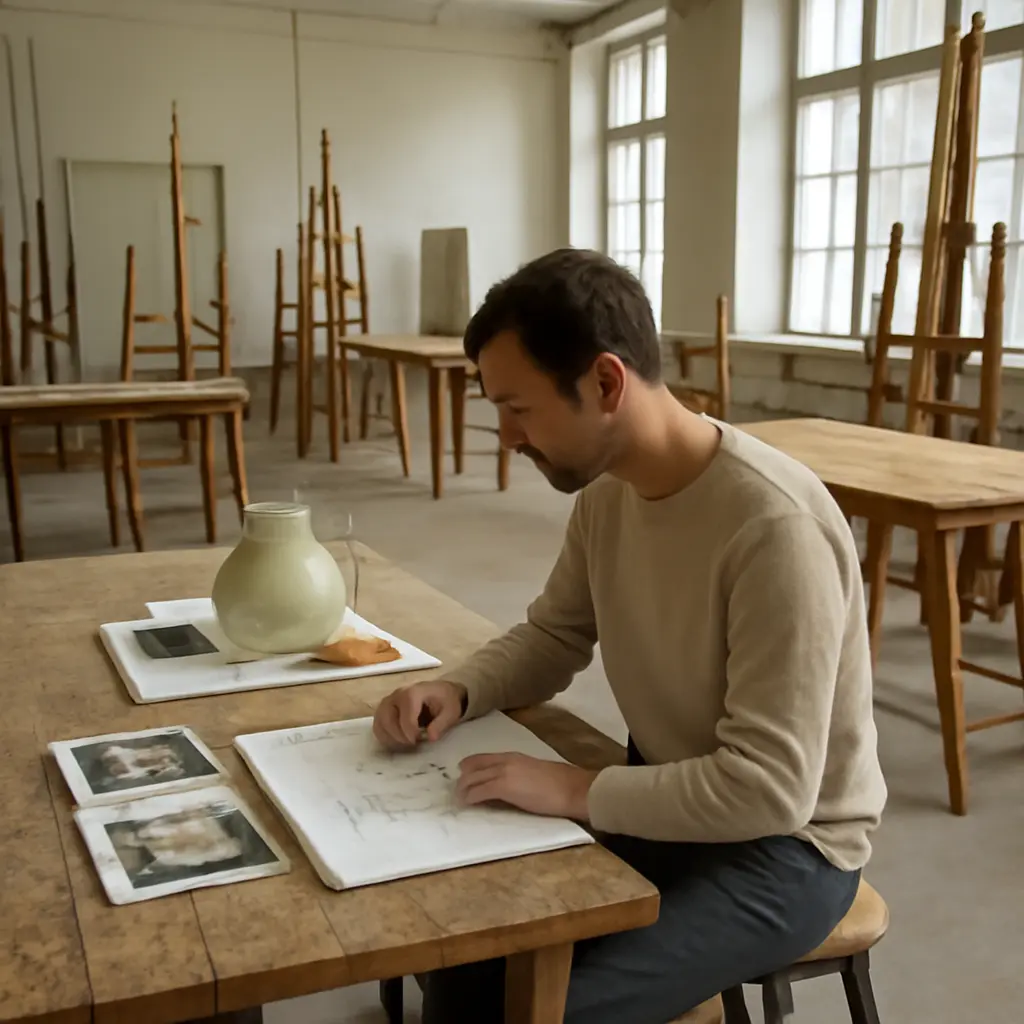
Imagine Better, Draw Faster—The Artist’s Shortcut Nobody Talks About
Imagine better, draw faster: the artist’s shortcut nobody talks about is visual reference research. Instead of inventing every object, pose, and lighting setup from scratch, artists study photographs, real-world examples, and reference libraries to make informed choices and move more quickly. This is not cheating or a substitute for skill; it is a practical way to reduce guesswork, improve accuracy, and save creative energy. Research on visual cognition and professional artists’ workflows supports the value of gathering visual information, while examples from animation, illustration, and design show how a well-organized reference process can turn an idea into a clearer, faster drawing.
Visual reference research improves artists’ drawing speed
Visual reference research is the purposeful collection and study of images or observations that help an artist solve a visual problem. It may involve checking anatomy, perspective, material, clothing, lighting, or a subject’s characteristic details before or during a drawing. The shortcut is not simply copying a picture: it is using relevant evidence to make decisions with less trial and error.
The approach matters because drawing combines many demanding tasks. An artist may need to remember a form, place it in perspective, invent a pose, and render its texture at the same time. Cognitive research has long shown that working memory is limited; the American Psychological Association describes working memory as the system for temporarily holding and manipulating information. A reference externalizes some of that information, leaving more attention for composition and expression. There is no universal, reliable percentage by which references make every artist faster, but the practical advantage is clear: they can prevent repeated guessing and correction.
Reference gathering as a drawing method
A reference is any visual or observational source consulted to answer a specific drawing question. A photo of a hand can clarify finger proportions; a mirror can help check a pose; a collection of building photographs can inform a believable streetscape. The key is to ask a focused question before searching—such as “How does this fabric fold at the elbow?”—rather than browsing endlessly.
This distinction connects reference use to visual problem-solving. In Drawing on the Right Side of the Brain, art educator Betty Edwards emphasizes learning to perceive relationships such as angles, edges, and negative spaces rather than relying only on symbolic assumptions. Reference study supports that kind of looking: it gives the artist something concrete to compare, measure, simplify, and interpret.
Why references reduce avoidable rework
Artists often lose time when a plausible-looking symbol replaces observation—for example, drawing a generic horse leg or a hand from memory when the scene requires a specific angle. A reference can reveal the structure that a remembered symbol leaves out. It is especially useful for unfamiliar subjects, foreshortened forms, unusual lighting, and complex objects.
The benefit is not that every drawing becomes mechanically accurate. Rather, references help artists identify what must be accurate and where invention is appropriate. A concept artist may use architectural photos to make a setting feel credible, then deliberately alter scale and silhouette to create a more dramatic design.
Reference types shape the artist’s visual decisions
Reference types are the different sources an artist can consult, including direct observation, photographs, 3D models, and curated image collections. Each answers different questions, so choosing the right type is part of working efficiently. A live object is valuable for understanding volume and changing light; a photograph is convenient for holding a fleeting pose; a 3D model can be rotated to inspect perspective.
Direct observation and life drawing
Direct observation means drawing from a subject in the physical world rather than relying solely on a reproduction. It develops attention to proportion, shape, depth, and changing conditions. Museums, studios, public spaces, and ordinary household objects can all serve as low-cost reference sources.
Life drawing is a focused form of direct observation in which artists draw a live model, often through timed poses. Short poses encourage artists to capture gesture and large masses before details, while longer poses allow closer study of anatomy and light. The U.S. National Endowment for the Arts has reported that participation in arts activities is associated with a range of social and educational outcomes, though such findings do not establish that any one drawing exercise makes an individual faster. For artists, the immediate value of life drawing is repeated practice in seeing and simplifying real forms.
Photographic and digital references
Photographic reference is a fixed image used to inspect a subject’s pose, surface, or lighting. Digital references include photographs, online collections, scanned sketches, and 3D assets. They are particularly useful when the subject is distant, temporary, dangerous to observe closely, or difficult to arrange in a studio.
Digital access also makes selection more demanding: a large image search can produce many near-duplicates and distract from the drawing. A disciplined artist saves only images that answer the visual question at hand and records source or usage details when relevant. Copyright rules differ by jurisdiction and use; consulting a reference does not automatically grant permission to reproduce or publish the source image.
Anatomy, material, and lighting references
Specialized references focus on one category of visual information. Anatomy references clarify how bones, muscles, and joints affect a pose. Material references show how surfaces such as glass, wool, or polished metal respond to light. Lighting references help artists understand the direction, softness, and color of illumination.
These categories are most useful when kept connected to the whole scene. A muscle diagram can be anatomically informative but may not match the character’s body type or pose; a dramatic lighting photo may not fit the intended setting. Compare references with the drawing’s proportions, viewpoint, and mood rather than applying them as isolated rules.
A focused reference workflow makes drawing faster
A reference workflow is a repeatable sequence for finding, evaluating, and applying visual sources. It prevents research from becoming a separate, open-ended activity. The goal is not to collect the most images but to find enough reliable information to make the next drawing decision.
Start with a specific visual question
A specific visual question identifies what is uncertain: the angle of a roof, the shape of a running dog’s silhouette, or the way a sleeve bunches at the wrist. This keeps the search narrow and makes it easier to decide when the research is complete.
For example, an illustrator drawing a character on a bicycle might need separate answers for the riding posture, the bicycle frame, and the direction of the cast shadow. Three targeted references are often more useful than a large folder of loosely related cycling images.
Choose and compare trustworthy references
A useful reference is clear enough to inspect and relevant to the drawing’s viewpoint, subject, and purpose. Comparing more than one source helps prevent an unusual photo angle or lens distortion from being mistaken for a general rule. When precision matters, artists can check a reference against direct observation, a second image, or a credible anatomy or technical resource.
The Library of Congress, museum collections, and government science agencies offer substantial public-facing image archives, though each collection has its own rights and reuse terms. Artists should check the stated conditions instead of assuming that an image found online is free to reproduce.
Extract structure instead of tracing detail
Extracting structure means reducing a reference to the information that matters: gesture, major masses, perspective, value grouping, and distinctive contours. This step turns looking into drawing knowledge. It also preserves room to change the design rather than becoming locked to the source image.
A practical sequence is to make a small thumbnail, mark the main axis and large shapes, check proportions, and only then add detail. If the reference is being used for a personal study, the artist can still compare the result with the source. If the work will be published or sold, originality and image rights deserve additional attention.
Set a stopping rule to avoid endless browsing
A stopping rule is a simple condition for ending reference search, such as “I can identify the pose’s main masses and the light direction.” Without one, image gathering can consume the time intended for drawing. Save a small, labeled set, begin the sketch, and return to research only when a specific uncertainty appears.
A useful test is whether another image would change the next mark. If not, it is probably time to draw. This creates a feedback loop: research, sketch, inspect the result, and look up only what remains unclear.
Reference use supports creativity when artists transform what they see
Reference use supports creativity when observation informs an original visual decision rather than replacing one. Artists can combine sources, change proportions, simplify forms, invent settings, and adjust lighting to serve a story. The reference is an input to the process, not the finished idea.
From observation to visual invention
Visual invention is the deliberate alteration or combination of observed forms to communicate a concept. A fantasy illustrator might study real bird wings for construction, then change their scale and color to fit a fictional creature. A storyboard artist might use a hallway photograph to understand perspective but redesign the space to heighten suspense.
This process is common across professional visual fields. The National Film Board of Canada’s animation resources and many studio production workflows emphasize preparation, thumbnails, and visual planning before final rendering. These practices illustrate a broader principle: gathering information early can make later creative decisions more deliberate, even though each project’s time savings will vary.
Using references ethically and clearly
Ethical reference use means respecting the source, the people depicted, and applicable licenses or laws. For commissioned or commercial work, artists should distinguish between using a source to study general information and reproducing its specific composition or expressive details. Keep attribution and licensing records when required, and obtain appropriate permission when the intended use calls for it.
When using a model or photographing people, consider consent and privacy, especially if images will be shared publicly. Good reference practice strengthens both the drawing and the artist’s professional process.
Conclusion: Imagine better by researching with purpose
Visual reference research is a practical artist’s shortcut because it reduces guesswork, supports observation, and directs attention toward the parts of a drawing that need invention. Direct observation, photography, anatomy and material studies, and carefully selected digital resources each serve distinct purposes. A focused workflow—ask a question, choose relevant sources, extract structure, and stop when the answer is clear—keeps research useful rather than distracting.
The broader lesson is that imagination and observation work together. References do not make creativity less original; used thoughtfully, they give artists stronger building blocks for original work. Choose one drawing you have been postponing, identify its biggest visual uncertainty, and find a reference that answers that question before you begin.
Sources: American Psychological Association, APA Dictionary of Psychology, Working Memory, https://dictionary.apa.org/working-memory; Edwards, Betty, Drawing on the Right Side of the Brain, TarcherPerigee, https://www.penguinrandomhouse.com/books/292112/drawing-on-the-right-side-of-the-brain-by-betty-edwards/; National Endowment for the Arts, Arts and Social Impact Explorer, https://www.arts.gov/impact/arts-and-social-impact-explorer; Library of Congress, Prints & Photographs Online Catalog, https://www.loc.gov/pictures/; U.S. Copyright Office, Copyright Basics, https://www.copyright.gov/circs/circ01.pdf; National Film Board of Canada, Animation resources, https://www.nfb.ca/animation/