Benefits of Learning to Draw Later in Life
Learning to draw later in life means developing drawing skills in adulthood or older age, whether as a beginner or after years away from art. It can be a rewarding way to practice observation, creativity, and focused attention—not a guaranteed treatment for memory loss or other health conditions. Research offers encouraging but qualified evidence: a 2014 study of older adults found that taking up visual art was associated with improved cognitive performance, while broader research on arts participation links creative activities with social connection and well-being. The benefits depend on the person and the activity, but adults can begin at any age and progress through regular, low-pressure practice.
Drawing practice builds skills at any age
Drawing is the practice of making images with marks, lines, shapes, and tones. The National Gallery of Art describes drawing as a fundamental form of visual expression that can involve diverse materials and purposes. For an adult learner, “learning to draw” may mean developing basic hand-eye coordination, studying perspective, sketching from observation, or experimenting with expressive styles. These related forms—often called observational, technical, and expressive drawing—offer different challenges while sharing a common foundation: noticing visual information and translating it into marks.
Observation and visual attention
Observational drawing means studying a subject directly and representing its proportions, edges, light, and spatial relationships. It encourages learners to look deliberately rather than rely only on what they think an object should look like. A cup, for example, becomes an exercise in comparing angles, negative space, and the shape of shadows. This focused looking can make everyday scenes feel more engaging, although evidence that drawing itself reliably improves general attention or cognition remains limited.
Creativity, experimentation, and self-expression
Expressive drawing prioritizes interpretation and personal meaning over precise imitation. Learners can use line, color, and composition to record memories, feelings, or imagined scenes. A 2014 study by researchers at George Washington University followed community-dwelling adults aged 62 to 88 who participated in visual-art classes or a comparison activity. The art group showed improvements on some measures of cognitive performance, including a test of executive function. The study was relatively small and does not establish that drawing alone caused the changes, but it offers a useful example of the potential value of sustained creative engagement.
Technical drawing and transferable skills
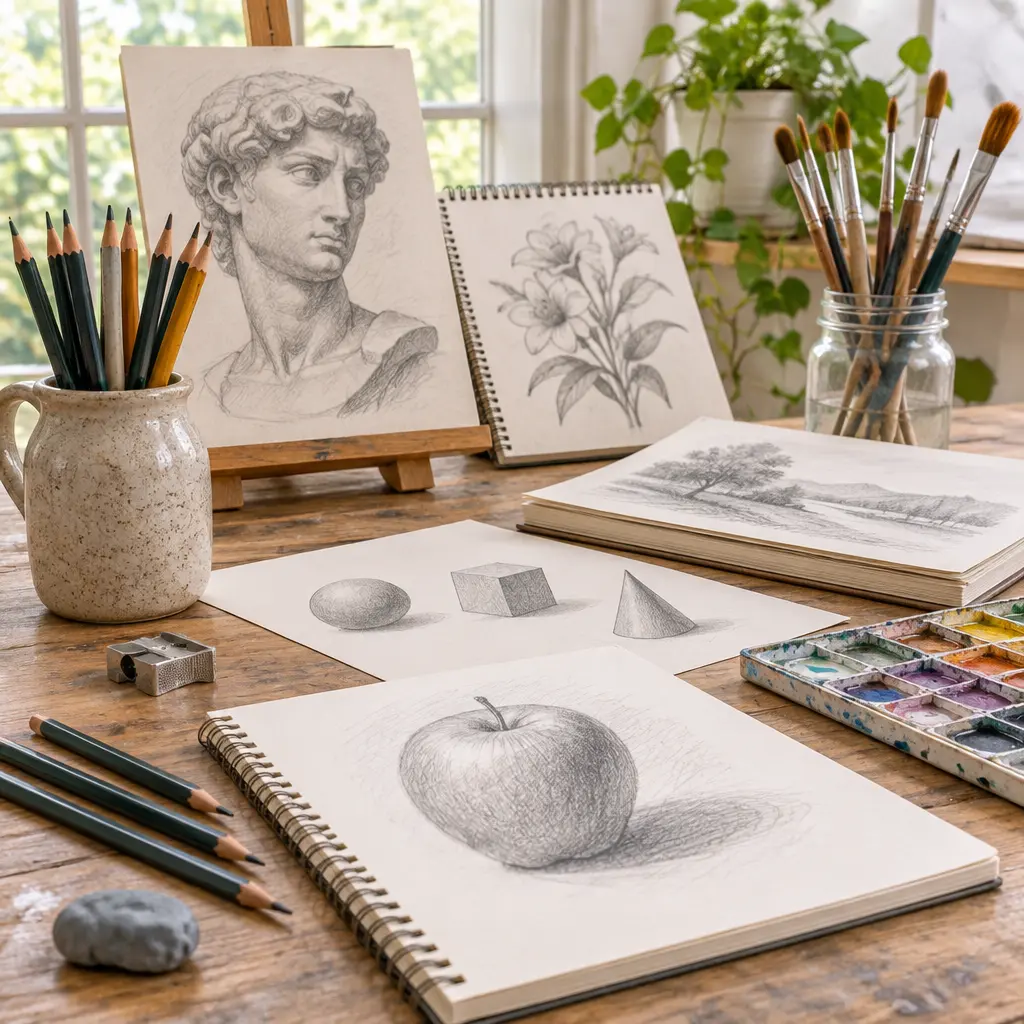
Technical drawing uses methods such as perspective, measured proportion, and value studies to represent objects or spaces consistently. Practicing these methods can develop patience, visual problem-solving, and comfort with revision. These are plausible learning outcomes, not guaranteed improvements in unrelated abilities. Beginners can build a foundation with simple exercises—drawing basic forms, comparing lengths, and shading a sphere—before moving to complex subjects.
Drawing supports well-being through meaningful practice
The benefits of drawing later in life are best understood as possibilities created by an enjoyable, repeatable activity. The National Endowment for the Arts’ research on older adults and creative engagement has examined links between arts participation, social connection, and aspects of well-being. Such findings concern arts participation broadly, not drawing as a standalone medical intervention. The distinction matters: a sketching class may offer routine, companionship, and a sense of accomplishment, but it should not be presented as a substitute for clinical care.
A manageable focus and a sense of progress
A short drawing session gives attention a concrete task: observe a contour, test a proportion, or adjust a value. Completing a small study can also make progress visible. The goal need not be a polished picture; a dated sketchbook page provides a record of practice and changing decisions. Setting modest goals—such as drawing for 15 minutes several times a week—can make learning easier to sustain than expecting rapid mastery.
Social connection through classes and shared projects
Group drawing classes, museum programs, and community art workshops combine instruction with conversation. Participants can compare approaches, receive feedback, and learn from people at different skill levels. The World Health Organization’s 2019 report on arts and health reviewed more than 3,000 studies across a wide range of arts activities, describing evidence of potential benefits for health and well-being while also noting that effects vary by activity and context. That review supports the broader case for accessible arts participation, not a claim that every drawing class produces a specific health outcome.
Adaptable practice for different bodies and circumstances
Drawing can be adapted to a learner’s mobility, vision, energy, and access to materials. A large pencil or marker may be easier to hold than a fine tool; a tablet can offer adjustable line weight and magnification; and a clipboard or angled surface may improve comfort. Learners with arthritis, low vision, or other access needs can ask an occupational therapist or instructor about practical adaptations. Comfort and safety matter more than following a single traditional method.
Adult drawing learners benefit from a realistic learning plan
Starting later does not require catching up with people who have drawn for years. Adult beginners can choose a learning path that matches their interests, schedule, and budget. A practical plan combines simple materials, regular practice, and feedback without turning every sketch into a test of talent.
Start with accessible tools and short exercises
A pencil, paper, and eraser are enough to begin. Draw a familiar object from several angles, fill a page with lines and shapes, or sketch a houseplant for ten minutes. These exercises develop comfort with materials and help learners notice proportion and form. Buying specialized supplies is optional; consistency and curiosity are more useful at the outset.
Use feedback without treating mistakes as failure
Feedback can come from a teacher, peer group, instructional book, or comparison between a sketch and its subject. Helpful critique identifies a specific next step—for instance, checking the angle of a tabletop—rather than labeling a drawing as good or bad. Keeping early attempts makes improvement easier to recognize. Adult learners may also benefit from choosing subjects they care about, since personal interest can make repeated practice more enjoyable.
Choose a sustainable routine
A sustainable routine is one that fits real life. Two or three brief sessions each week may be more practical than an ambitious daily schedule. Learners can alternate structured exercises with free sketching, attend a class when available, and take breaks to prevent discomfort. If a project becomes frustrating, returning to a simpler subject is a sensible adjustment, not a setback.
Conclusion: Drawing later in life offers room to learn and connect
Learning to draw as an adult can develop observational and technical skills, provide a creative outlet, and create opportunities for routine and social connection. Research on visual-art programs and broader arts participation is encouraging, but it does not prove that drawing prevents cognitive decline or guarantees better health. The strongest practical case is that drawing is adaptable, relatively accessible, and rewarding for many people when approached with realistic expectations. Choose a simple subject, set aside a short practice session, and explore a class or sketch group if you want company and feedback.
Sources: National Gallery of Art, “What Is a Drawing?”, https://www.nga.gov/stories/articles/what-drawing.html; George Washington University, “Creativity and Aging Study: The Impact of Professionally Conducted Cultural Programs on Older Adults,” https://www.gwu.edu/~magazine/archive/2006_art.shtml; National Endowment for the Arts, “The Arts and Aging: Building the Science,” https://www.arts.gov/impact/research/publications/arts-and-aging-building-science; World Health Organization, “What Is the Evidence on the Role of the Arts in Improving Health and Well-Being? A Scoping Review,” 2019, https://www.who.int/europe/publications/i/item/9789289054553.